August 23rd, 2007 by Benjamin Duranske
 World of Warcraft publisher Blizzard Entertainment has been sued by Founder Electronics Co. Ltd., a Beijing company. Founder alleges the fonts used in Blizzard’s Chinese version of World of Warcraft infringe Founder’s copyright.
  Beijing High People’s Court recently accepted the suit. I have no idea how Chinese copyright law works (though based what I saw in Macau last year when was there taking depositions, it basically doesn’t) and I don’t know the facts here, but I’ll keep watching this to see how it plays out.
For what it’s worth, in the U.S., you can’t copyright a typeface, though you can copyright the code used to draw the typeface on a screen. In other words, if you figure out a way to make your typeface look exactly like someone else’s on your own, you’re fine. If you use someone else’s code (e.g. font) without licensing it, however, you may be liable for infringement.
Any Chinese copyright law experts out there want to weigh in?
Posted in Blizzard, Copyright Law, Founder v. Blizzard, Lawsuits, Providers, Virtual Law, Virtual Law Practice, Virtual Worlds & Games, World of Warcraft | 5 Comments »
Related Posts on Virtually Blind
August 23rd, 2007 by Benjamin Duranske
Discovery proceeds in the Bragg v. Linden Lab case. Bragg recently served two sets of document requests on Linden Lab, and has made them available. 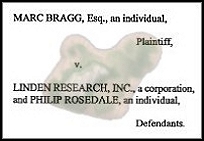 As is my policy on live lawsuits, I’ll run the excerpts without significant commentary. I expect, however, that these excerpts will raise some interesting questions for readers.
The first set (.pdf). served on July 23, sought just five categories of documents. These included unedited chat logs that Linden Lab plans to use to support its counterclaims, all documents supporting the counterclaims Linden Lab might use at trial, and Linden Lab’s document retention policies. A response to this is set of requests is due today, and I will be interested to see if Bragg posts it, along with other discovery responses. (Although a note for non-litigators: parties’ responses to document requests aren’t typically very illuminating, as the documents themselves aren’t part of the formal responses.)
The second set (.pdf), served August 17, is much more expansive, seeking documents in response to 110 individual requests. Excerpts below.
Read the rest of the post »
Posted in Bragg v. Linden Lab, Civil Procedure, Commentary, Contract Law, Criminal Law, Lawsuits, Linden Lab, Property Law, Providers, Second Life, VB Features, Virtual Law, Virtual Law Practice, Virtual Worlds & Games | 7 Comments »
Related Posts on Virtually Blind
August 23rd, 2007 by Benjamin Duranske
 Recently, VB began a new feature: closely examining filings in cases related to virtual law. Unlike most posts here, these posts contain only a tiny bit of opinion and not much personality at all. As I pointed out when I first ran one of these, there’s an important reason for that. Since these posts are a departure from my usual style, I am going to repeat that reason now in a standalone post so I can permanently link to it in the sidebar.
Regarding commentary on filings: I am an attorney, and I need to be able to take positions in the future that are in my clients’ best interests on both sides of narrow issues like those that are likely to come up in filings. If I plastered this blog with my personal opinions about specific discovery disputes, the timing of specific motions, and judges’ likely reaction to various tactics, I would probably end up seeing those words in a filing against my future clients at some point. That’s not fair to them, nor is it very good for business.
My compromise is this: I will call readers’ attention to things that most litigators would notice as anomalous and I will highlight excerpts from the filings that will be interesting to readers, but I’m not going to make broad predictions or generally critique active filings. There’s just too much potential that doing so could hurt a future client. On the other hand, before suits have been filed or charges have been brought, I have a lot more leeway to write in my typical “voice” because the topics are more general. More on the gray areas below.
Read the rest of the post »
Posted in Commentary, Contract Law, Criminal Law, Linden Lab, Patent Law, Providers, Second Life, Securities Law, VB Features, Virtual Law, Virtual Law Practice, Virtual Worlds & Games | 5 Comments »
Related Posts on Virtually Blind
August 22nd, 2007 by Benjamin Duranske
 Actually, you may not want this particular job. It appears to pay $9.00 an hour and require no experience. At anything. I’m fairly sure some In-N-Out Burger locations offer higher pay and have higher standards. But if you happen to be at the University of Chicago law school, are looking to pick up some virtual street cred, and have an interest in conducting “Economic Experiments in Second Life,” it’s your big chance.
Okay, I’ve got nothing but respect for the University of Chicago’s law school, but there’s something kind of grotesque about offering nine bucks an hour to people with “no experience” to do experiments that, presumably, involve other people’s money. I mean… isn’t the idea that kids with no experience can conduct economic experiments in Second Life sort of, well, what we all recognize is a big part of the problem right now?
There aren’t a lot of facts, so I’ll withhold judgment on this particular plan. And at minimum, it at least means that yet another law school is taking a serious look at virtual worlds. In the long run, that’s probably a good thing, since it means more young attorneys with a passion for technology and an interest in issues that matter in virtual worlds will be learning about these spaces.
Posted in Contract Law, Criminal Law, Second Life, Securities Law, Virtual Law, Virtual Law Libraries, Virtual Law Practice, Virtual Legal Education, Virtual Worlds & Games | 1 Comment »
Related Posts on Virtually Blind


