Subscribe to
Posts
Comments

Discovery is heating up in the Bragg v. Linden Lab case, and Marc Bragg has posted a number of related documents on his web site.
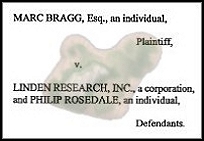
Bragg v. Linden Lab CaptionFirst, we now have Bragg’s initial set of responses to interrogatories (.pdf). His primary arguments (which you’re probably already familiar with from his recent motion to dismiss) are laid out fairly concisely in this document. There’s not much new material here, but a few statements related to damages are new; I’ll excerpt them below.

As usual, keep in mind that these passages advocate Marc Bragg’s position, and haven’t been proven yet.

Plaintiff currently approximates that he provided $13,900 U.S. dollars and one million Lindens to Defendant Linden for tier payments, land purchases, account credit, lindens in account, and purchases from third party vendors.

Plaintiff’s attorneys fees exceed $100,000 and are growing on a daily basis Plaintiff is also entitled to treble damages, punitive damages and statutory damages, as more fully documented in the Complaint, in addition to injunctive and equitable relief.

Every dollar paid to Defendant Linden has been lost. Every dollar paid to any third party for virtual items and/or land has been lost. Plaintiff’s U.S. Currency was also stolen by Defendant Linden.

Plaintiff’s ongoing rentals, firework shows, and projects under construction were generating approximately $50.00 U.S. monthly; and purchase and sale of land was generating approximately $1,200.00 U.S. monthly.

Second, you can look at Linden Lab’s formal responses to Bragg’s first set of document requests (.pdf) and Bragg’s responses to Linden Lab’s requests (.pdf), but I’d not bother with these; formal document request responses are essentially procedural, and are not all that interesting.

What is interesting is that Bragg has also made three sets of actual documents provided by Linden Lab in response to his document requests available on his site. I would like to see Bragg make the documents he has provided to Linden Lab available too if he’s going to put Linden Lab’s documents up, but I’ll link to these anyway since they’re newsworthy (and because there is nothing preventing Linden Lab from posting Bragg’s documents as well).

You can find these documents here, here, and here (all three are .zip files that unzip to .pdfs). The first link will take you to Linden Lab’s documents labeled 1-100, and the second will take you to 101-200, and the third set contains documents 201-300.

Ironically, the link to the third set on Bragg’s site was actually linked to the first set when I visted, but I was able to find the third set zip file by backwards browsing (I typed a “3″ where there had been a “1″ in the URL). That, of course, is precisely what Bragg says he did when he bought underpriced land. Given the obvious parallel, I have to wonder if the link snafu is intentional, and if they’re tracking Linden Lab downloads.

The documents appear to consist of old versions of the Terms of Service, old forum posts, and complete chat logs, some of which were attached to the earlier motion. It looks like there is a lot of interesting stuff in there if you’re inclined to spend some time digging into it, and I’d love to see what readers can find in these documents.

Finally, Bragg has noticed Linden Lab CEO Philip Rosedale for a personal deposition on September 21. These things typically do not take place when initially scheduled, but this gets the ball rolling. There’s nothing substantive in the notice, but for the record, you can view it here (.pdf).

Email This Post Email This Post
Print This Post (Printer Friendly Formatting) Print This Post (Printer Friendly Formatting)


Related Posts on Virtually Blind

U.K. website bitrealty.com (which appears, primarily, to resell real-estate domains) is running a bizarre, but oddly BitRealty.com Logocompelling, futuristic virtual property law hypothetical set in “Third Life.”

Once you get past the Guy Noir-ish purple prose (the real estate attorney is “highly intelligent and powerful,” and her avatar is “beautiful and shapely”), you’ll find that the post raises some good virtual law questions in a fairly accessible way. I’d not be surprised if it attracts some interesting comments.

Here are a few excerpts from the post to get you started:

It is the year 2030 and the laws regarding virtual real estate are up for grabs. Fred is a 26 year old human male living alone within the secure confines of New York City. Like most young people in 2030, in order to escape reality, Fred spends a large part of his real life plugged into the electronic grid, immersed in massive multiplayer virtual environments and economies, and inhabiting a virtual character with a separate identity….

…Another aggressive virtual land speculator was a highly intelligent and powerful real estate attorney named Aria, who lived in San Diego. Through alter ego in Third Life, a beautiful and shapely female avatar named “Athena”, she had been acquiring land in 100 acre parcels for over 15 years. As a legal scholar, skilled programmer and seasoned technology intellectual, Aria had realized early on that, while the laws and rules governing virtual land ownership in Third Life, and elsewhere online, were still being defined, they were clearly taking the shape of centuries-old real property laws that had been created in England, but that had been widely adopted and practiced in the U.S. and elsewhere….

…If the implications and rights in the title and/or deed to virtual property reasonably resembled that of a real property title, why then should virtual real estate ownership be any different than in the real world? To some extent this was a rhetorical question: she was confident that, in the end, there would be no difference at all.

At the end, the post poses some good questions, including: “Do you believe that virtual property matters should be played out in a virtual court as opposed to a real world scenario?” and “Should real property law concepts such as adverse possession apply in virtual property environments?

I think these questions are going to be answered much sooner than 23 years from now, but in my book, you get a little artistic license when your protagonist is a “legal scholar, skilled programmer and seasoned technology intellectual” named Aria, who has “pictures of her beautiful avatar Athena sunbathing in different areas of the parcel in question.”

Email This Post Email This Post
Print This Post (Printer Friendly Formatting) Print This Post (Printer Friendly Formatting)


Related Posts on Virtually Blind

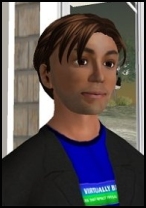
The picture below? That’s my avatar in Second Life. His name is ‘Benjamin Noble’ and he’s been my representative in that virtual world from the beginning. But why should you believe that? So far, you’ve had no way to know the real name, geographic location, gender, or age of the person controlling ‘Benjamin Noble.’ 'Benjamin Noble,' Benjamin Duranske's Second Life AvatarThat’s about to change, and I couldn’t be happier about it. I even think that somewhere in his little pixelated cortex, my avatar is happy too. (Sidenote: thanks to Nobody Fugazi from Your2ndPlace.com for the custom shirt for ‘Noble’).
Why is ‘Benjamin Noble’ about to become so much more closely tied to me? Because Linden Lab just rolled out details on identity verification.

The system is ostensibly focused on verifying age for access to adult areas, but Linden Lab didn’t limit it to age. So the long term impact will not be limited to adult content providers (though I suspect they’re mostly just fine with knowing they’re not letting kids access their material). The people who will most benefit from this are business people and professionals who have been limited by an inability to prove who we are, know who we are talking to, and make enforceable agreements in-world.

That all changes, once verification goes live.  The long-term possibilities are huge. Off the top of my head, I see contracts executed in-world, legal representation that starts in-world, and virtual employment that goes beyond warming camp chairs. And that’s just the beginning.

The important details are:

  • Verification is voluntary.
  • You can verify your age, location, gender, and/or name.
  • You can do it piecemeal (e.g. just age, for access to restricted content).
  • If you don’t verify age, you can’t access restricted parcels.
  • It will be free at first, but there will be fees imposed later.

Some readers aren’t going to like this, but it will help ensure the success of the grid as a place for business, which is good for everybody in the long run. Previously, the lack of any way to prove who you are in virtual worlds made contracts functionally impossible. Not any more. The full impact won’t be known for a while, and there are sure to be some snags, but overall, I am convinced that this was a necessary, positive step that will help move the economy beyond point-of-sale transactions.

As the post from Robin Linden says:

[F]or Residents, it gives them the chance to independently verify certain aspects of their identity (their name, age, location and sex for instance) if they choose to. This will help establish trust by removing a layer of anonymity for those they interact with. It’s much easier to trust someone who puts their name behind their words and actions.

For lawyers who are contemplating a virtual world practice, it’s fantastic news. I have, in the past, cautioned attorneys against giving legal advice or taking on representation that is entirely in-world on the grounds that if they didn’t know who their clients were and where they were located, the lawyers would run a serious risk of creating a conflict of interest, and potentially be on the hook for unauthorized practice of law. Now, I’d modify that advice. Attorneys who are giving legal advice to anonymous avatars are potentially making a big mistake, but with verification on both sides and sufficient attention paid to local rules on attorney-client confidentiality, contact with clients and potential clients via avatars is much more reasonable.

[Note: Edited August 29, 2007 for clarity per comment #10.]

Email This Post Email This Post
Print This Post (Printer Friendly Formatting) Print This Post (Printer Friendly Formatting)


Related Posts on Virtually Blind

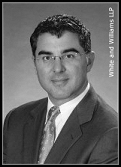
Virtually Blind recently conducted an in-depth telephone interview with Jason Archinaco, Marc Bragg’s attorney in the case against Linden Lab and Philip Rosedale. Archinaco is a partner at White and Williams, in Pittsburgh.

We discussed topics as diverse — and divisive — as Linden Lab’s accusation that Bragg violated a California criminal statute, the potential for punitive damages, Bragg as a possible witness, balancing the rights of virtual world users against the rights of developers, and the nature of virtual property.

Jason ArchinacoVirtually Blind: When did you get involved in this case?

Jason Archinaco: Sometime around May of 2006. Mr. Bragg had originally filed the case in Pennsylvania state court at the magistrate level. He withdrew that complaint and we filed in state court in Pennsylvania in the Court of Common Pleas. Linden Lab argued that there was more than $75,000 in controversy in the case, and removed the case to Federal Court in the Eastern District of Pennsylvania, and that’s where the case is now.

I’ve played a lot of different online games. Ultima Online, EverQuest, World of Warcraft, Anarchy Online. My addiction began with an Atari 2600 and stand up quarter machines.

VB: Do you have other clients with virtual world or game connections?

JA: Yes, but I can’t identify any of them publicly at this point.

VB: Do you participate in virtual worlds or games yourself?

JA: I’ve played a lot of different online multiplayer games. Ultima Online, EverQuest, World of Warcraft, Anarchy Online. I’ve done some beta testing too, right now I’m in the beta for Richard Garriott’s Tabula Rasa. My addiction began with an Atari 2600 and stand up quarter machines.

VB: Do you participate in any non-game virtual worlds, like There or Second Life?

JA: I logged in to test drive Second Life when I started representing Mr. Bragg. So I have an avatar in Second Life, but I think he’s stuck over an ocean somewhere.

VB: Beyond Marc Bragg’s individual issues, do you view this case as saying something important about virtual law?

JA: Yes. There are a lot of different things that this case will address. The biggest one is the intersection between ownership of and access to virtual items. These are different things, and the question is how the Court will reconcile those concepts.

If someone sells virtual land or items, that should result in a consumer having the right to access things that they bought.

Also, we want to determine what law will be applied. I’ve urged a similar law to that of “landlocked property.” Basically, if I sell a property that is entirely surrounded by someone else’s property, an easement by necessity is going to be created so that the buyer can access the land. Same thing here, if someone sells virtual land or items, that should result in a user or consumer having the right to access things that they bought.

Another line of thought is that buying virtual land or items is like buying a membership in a club. Sure, someone could terminate that membership, but if they do, there’s a California law that says the member should be entitled to due process in advance of being terminated from the club. Any contract provision that states otherwise is invalid.

What’s happening now is that Linden is contesting the idea that they sold land, even though they told everyone that they were selling it before.

So the first issue is ownership, the second is access, and the third is if access is cut off, what is the recourse for consumer?

Read the rest of the post »

Email This Post Email This Post
Print This Post (Printer Friendly Formatting) Print This Post (Printer Friendly Formatting)


Related Posts on Virtually Blind


Page 59 of 87« First...«5758596061»...Last »