Subscribe to
Posts
Comments

The New York Times is running a good overview of courts’ rejection of video game violence laws by regular game writer Seth Schiesel. Though only tangentially related to VB’s usual coverage, it’s worth the click.

Summary: the article highlights an Oklahoma court’s recent move to block regulation of violent games. It notes that under “the Constitution’s protection of free speech, federal judges have rejected attempts to regulate video games in eight cities and states since 2001″ and “no such laws have been upheld.” Ronald Collins of the First Amendment Center is quoted saying that “uniformity in declaring a category of laws unconstitutional is very rare.”
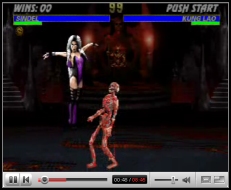
Mortal Kombat Fatalities on YouTube

The image to the left links to a YouTube compilation video of Mortal Kombat “Fatalities” — an early target of complaints about game violence.

On a related note, VB reader Dr. Jerald Block recently sent me a couple of links related to work he has done regarding video game violence, specifically the relationship of video game violence to the tragic events at Columbine High School in 1999. The first is a Destructoid interview with Dr. Block. Dr. Block argues that game violence can provide an outlet for violent tendencies that can — at least temporarily — temper the desire to do real violence. The second is a link to Dr. Block’s paper, “Lessons from Columbine: Virtual and Real Rage” (.pdf) that explains the theory. The paper is surprisingly readable for an academic article, and I highly recommend it.

Finally, though the methodology is a little suspect (and tongue in cheek), Jeff Freeman’s juxtaposition of two graphs — violent video game sales and violent crimes — on mythicalblog.com actually raises a fair point. Over the last ten years, video game sales (and with them violent video game sales) are way, way up, while violent crime is way, way down. Sure, there’s a causality question, but it’s nice to have something to toss back at the usual suspects when they leap for the game violence bandwagon every time something bad happens.

Email This Post Email This Post
Print This Post (Printer Friendly Formatting) Print This Post (Printer Friendly Formatting)


Related Posts on Virtually Blind

Xfire Debate Splash[Editor's Note: If you missed this event, Xfire has made a transcript of the "Main Floor" debate between the panelists available here. There's also a transcript of the concurrent debate among Xfire users, here. Thanks to the Xfire guys for running this, and to Joe Blancato for hosting. Original post below.]

————————————————————————————————————————-

Readers may be interested in a debate / panel discussion on game currency to be held today at 3PM Eastern time, hosted by Xfire. I’m one of the seven panelists. The others include a technology writer, the lead artist for Arden, a professor at USC, ZAM Network’s Content Manager, PR manager at NHN USA, and the CEO of Sparter. The event is hosted by Joe Blancato, Associate Editor at The Escapist magazine, and founder of Waterthread.org. It should be an interesting discussion.

Participation requires a quick software download and setting up a user ID, but it is all free, and the Xfire software is easy to use.

Here is the description of the event from Xfire:

The Xfire Debate Club presents its 7th meeting as a discussion of the driving force behind your favorite game, money. Online games today are more dependant on in-game currency than ever before. With top minds from the industry, journalism, and academia, we will talk about the different design approaches to make virtual exchange useful, fair, and enjoyable.

Edited to add links to transcripts on August 22, 2007.

Email This Post Email This Post
Print This Post (Printer Friendly Formatting) Print This Post (Printer Friendly Formatting)


Related Posts on Virtually Blind

Bragg v. Linden Lab CaptionIn the Bragg v. Linden Lab case (see VB’s previous coverage for background) defendants recently served interrogatories and document requests on plaintiff Marc Bragg. The interrogatories are available here, and the document requests are here (both of these documents are .pdf files). Linden Lab also recently filed amended counterclaims (available here (.pdf)) that shed more light on the mechanism Bragg allegedly used to buy land, and further explicate Linden Lab’s allegations of a fraudulent conspiracy between Bragg and other users.

Just as with Bragg’s last substantive filing against Linden Lab, I must point out that litigation documents put the side the drafted them (this time, Linden Lab) in the best possible light, and the other side in the worst. Litigation documents are, by their very nature, completely one-sided. So, as before, I must caution readers to avoid rushing to judgment based only on pleadings.

Incidentally, for non-litigators, “interrogatories” are questions that the recipient must (generally) answer, and “document requests” are formal requests for copies of electronic and paper documents that the recipient must (generally) comply with.

Highlights from these documents and limited commentary below.

Read the rest of the post »

Email This Post Email This Post
Print This Post (Printer Friendly Formatting) Print This Post (Printer Friendly Formatting)


Related Posts on Virtually Blind

About a month ago, There.com quietly made a policy change that gave users some serious tools to enforce in-world copyright infringement. More Than Words, a site that follows There.com, There Shirtreported that the policy “has some teeth,” and indeed, it does. Three strikes and you are not only banned from There.com, so are all of your other avatars, any associated credit cards, and the hardware used to access the service.

Notably, this policy is specifically designed to protect resident designers from having their work stolen by other users, what There.com calls “peer-to-peer texture theft,” and what is alleged to have triggered a recent lawsuit between Second Life users. Larger corporations that discover trademark abuse and copyright infringement in There.com can presumably use this service too, but There.com’s submission process for user-created content filters out most infringement of big corporations’ intellectual property already.

Here is a link to There.com’s official policy, and here is management’s straightforward justification:

Unauthorized asset use, more commonly known as “texture theft,” is a form of copyright infringement. It is when a Developer takes a texture or model file created by There or another Member Developer and incorporates it, in whole or in part, into his/her submission without having authorization from the copyright owner.

The message here is that There.com is straightforward about actively helping protect users’ intellectual property. Content developers are encouraged to alert There.com management of potential infringement, and management says that it actively investigates every claim. Even a first offense, if an “extreme case,” can result in the banning of all avatars and credit cards associated with the account. There.com has also put in place a policy to prevent time-wasting witch hunts and associated drama: after two warnings, management simply ignores further alerts from trigger-happy developers.

Email This Post Email This Post
Print This Post (Printer Friendly Formatting) Print This Post (Printer Friendly Formatting)


Related Posts on Virtually Blind


Page 62 of 87« First...«6061626364»...Last »