Subscribe to
Posts
Comments

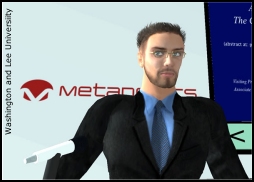
Professor Joshua Fairfield (currently a visiting professor at Washington and Lee University School of Law) will present his paper, “Anti-Social Contracts,” at the Monday, September 24, 2007 Metanomics session in Joshua Fairfield's Avatar, from Washington and Lee UniversitySecond Life (11:00 AM Pacific). From the press release from Washington and Lee University:
Fairfield’s lecture will discuss how private-law contracts (known as End User License Agreements, Terms of Use, or Terms of Service) became the new public law of virtual worlds. Such contracts govern the day-to-day lives of millions of virtual world residents, and have grown so powerful that they may completely eclipse other cherished legal rights, including ownership of private property or freedom of expression.

Professor Fairfield’s paper has already sparked some great discussion, and I suspect that the session will also. The first Metanomics session last week maxed out the sim, so if you are a Second Life user and are interested in attending the event live, I suggest showing up on the early side. All Metanomics sessions are also available on SLCN.TV.

Email This Post Email This Post
Print This Post (Printer Friendly Formatting) Print This Post (Printer Friendly Formatting)


Related Posts on Virtually Blind

Virtual Worlds Fall 2007 LogoThe Virtual Worlds 2007 conference in San Jose October 10-11 (VB is one of Virtual Worlds 2007′s media partners) just announced a late-addition session entitled Combating IP Theft in Virtual Worlds: A look at EROS, LLC’s Landmark Avatar Lawsuit, in the Entertainment and Marketing track. Eros’ CEO, Kevin Alderman (‘Stroker Serpentine’ in Second Life) is presenting the case study.

Regular VB readers will already be familar with the progress of Eros v. John Doe, but it should be interesting to see what Alderman himself has to say from the perspective of a content creator who is alleging infringement.

Email This Post Email This Post
Print This Post (Printer Friendly Formatting) Print This Post (Printer Friendly Formatting)


Related Posts on Virtually Blind

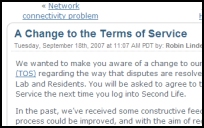
Screenshot of Post Changing TOSToday, Second Life creator Linden Lab changed Second life’s Terms of Service regarding dispute resolution.

The move appears to be a direct result of the recent decision in the Bragg case finding the previous arbitration clause unconscionable. The new clause makes two significant changes, one that dramatically benefits small claimants, and one that makes it somewhat more expensive and burdensome to bring big claims.

First, the new Terms of Service (you can find the old version here) require that all actions against Linden Lab claiming more than $10,000 or seeking injunctive or other equitable relief (like account reinstatement) must be filed in California courts. Specifically, these actions must be filed in “courts located in the City and County of San Francisco, California.”

This part of the change benefits Linden Lab by reducing the likelihood that it will have to defend suits scattered around the country. It also puts lawsuits against Linden Lab in Linden Lab’s backyard, in front of generally tech-savvy judges who see a lot of consumer claims against technology companies, and who may be less sympathetic to consumers than judges elsewhere. If you file in the wrong place, you give Linden Lab the right to seek up to $1000 in attorney fees that they spend getting your case dismissed.

On the other hand, the new terms also create a special class of claims under $10,000 that are to be handled via non-appearance arbitration. This change is very good for users, as the new clause replaces one that required a full-blown arbitration proceeding before a three-person panel, which could easily cost more than $10,000 itself (that is essentially why the clause was declared unconscionable in the Bragg case). Non-appearance arbitration can actually be quite inexpensive, and, notably, it could even be conducted in Second Life. The arbitrator must be an established ADR provider, must have published guidelines for dispute resolution, and must be a “retired judge or attorney with legal expertise in the subject matter of the dispute.”

In a FAQ on the new policy, Linden Lab refers users to the National Arbitration Forum, an arbitration group that Linden Lab says charges consumers “at most $185.00 in disputes between consumers and businesses where the total amount of damages sought is less than $10,000.00 USD with the remainder of the cost to be carried by the business.”

Collectively, the changes make small claims against Linden Lab much easier (and given that they were essentially impossible before, that’s good news for users), but also make big claims somewhat more expensive. Overall, given the fairly small amounts of money involved in many disputes between residents and Linden Lab, it is probably a good change for Second Life users.

Hat tip to Second Life’s ‘Eric Reuters,’ who alerted me to the change, and who has also posted an article about it at reuters.com.

Email This Post Email This Post
Print This Post (Printer Friendly Formatting) Print This Post (Printer Friendly Formatting)


Related Posts on Virtually Blind

Quicklinks are back, and they’re quicker than ever. One link, one sentence. I tried to get rid of them, but there are simply too many developments in virtual law for me to cover everything with individual posts. So I’ll run the feature whenever I have a backlog of interesting items. Here’s today’s batch.

  • Possible Class Action Lawsuit Against Ad Farmers in Second Life (via your2ndplace.com): My quick take is that there is probably a reasonable suit at least under the theory of breach of a third-party beneficiary contract, but that given the tone and approach of the announcement, lawyers aren’t actually involved at this point.
  • Entropia Universe Kills In-World Lottery (via entropiaforums.com): Even the people running it didn’t seem all that surprised, and I suspect that’s because Entropia doesn’t mince words — it is a “Real Cash Economy” so real laws about money apply.
  • Chronicle of Higher Ed. Ponders Lawsuits Over Virtual World Classes (via The Chronicle of Higher Education): Obvious conclusion here is that the relatively small possibility of a lawsuit (I suppose under the theory of negligent exposure to intentional infliction of emotional distress, and that’s a really big stretch) should be covered with a waiver, just like for rock climbing classes and psychological lab sections.

Email This Post Email This Post
Print This Post (Printer Friendly Formatting) Print This Post (Printer Friendly Formatting)


Related Posts on Virtually Blind


Page 55 of 87« First...«5354555657»...Last »