Linden Lab’s Gene Yoon on Metaversed’s Metanomics: Micro v. Macro and the Second Life Economy
November 7th, 2007 by Benjamin Duranske
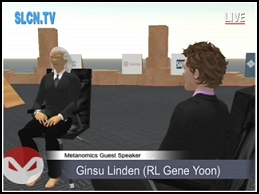 Gene Yoon, Linden Lab’s former General Counsel and current Vice President of Business Affairs, spoke in Second Life yesterday as part of the Metanomics / Metaversed series of events, hosted by Cornell’s Robert Bloomfield. SLCN has made a video of the event available. Yoon focuses on economic policy in virtual worlds, not legal issues, but obviously, there’s a lot of crossover.
The discussion quickly turns from macro to microeconomics, because Yoon refers to the Linden Dollar “a product” and encourages users not to think of the world as possessing an economy. Throughout the discussion, he consistently discourages the use of terms like “monetary policy” and “macroeconomics” in reference to Second Life. Bloomfield pushes the macroeconomic angle, while Yoon wants to draw a line between the user experience, where he says metaphors regarding “economics” and “ownership” do apply, and the business and legal world, where he says the metaphors are largely invalid. His comments will almost certainly be controversial.
Yoon’s position, while perhaps not formally reflecting Linden Lab’s corporate policy, is exactly the position that the company has to take from a legal perspective. As long as the land and money metaphors don’t apply beyond “the user experience,” then the small-print EULA and TOS provisions (which, in part, run counter to the big print) can operate to preserve Linden Lab’s ultimate control of key aspects of the offering — Lindens, land, and objects — that users typically feel they “own.” This question is at the heart of both academic inquiries and litigation over the nature of “virtual property.”
Yoon and Bloomfield also discuss micropayments, intellectual property rights, alternative dispute resolution, Linden Lab’s relatively laissez-faire policies, competition for Second Life, and more.
Commentary
This is off topic a bit, but I want to compliment Robert Bloomfield’s Metanomics series, and Nick Wilson’s Metaversed site generally, because they are becoming my favorite source for serious business and economic discussions about metaverse issues. The speaker series is outstanding, and Metaversed is rapidly turning into a business counterpart to Terra Nova.
I have to say that I generally find podcasts, interviews, presentations, and the like that focus on serious issues to be waste of time; it’s just faster to read research papers. So I was a little reluctant to dive to these. But the Metanomics series, which started out strong, has only been getting better.
Recently, they’ve started taking on the feel of a high-quality PBS interview show, from the brief mention of underwriters at the beginning through the fairly academic and respectful pace that Bloomfield sets. Picture Charlie Rose talking to Alan Greenspan. Bloomfield isn’t attacking his guests (to the occasional disappointment of the Second Life audience) but he shouldn’t be; a good interviewer knows that evasive answers tell smart viewers a lot, and Bloomfield does a good job pointing them out without antagonizing his guests. It’s a fine line, but it works, and the format lets Bloomfield get guests like Yoon and ‘Anshe Chung,’ who don’t often make public appearances.
Wilson has recently made significant cosmetic improvements to the main venue that these are held in as well, and more importantly, has involved a number of partner sims, allowing more residents to participate in the live discussions. He has also been proactive in keeping the audience free of griefers and eliminating problems before they get out of hand. The series is well attended and the backchat is great, but if your schedule doesn’t let you make these live, watching them on SLCN later (or even just listening to them while making dinner, as I often do) is a good substitute.


Related Posts on Virtually Blind
- Metanomics Launches, Announces 2007 Speakers: "Cornell Professor Robert Bloomfield, in association with Metaversed,..." (2 comments)
- Robert Bloomfield in the Guest Chair on Metanomics, Monday, September 22 at Noon Pacific: "The fall season of the popular in-world metaverse business and policy..." (0 comments)
- Metanomics Panel on Second Life Banking Rules Change Today, 11 AM Pacific [Updated]: "Metanomics, the popular in-world speaker series, will feature a panel..." (10 comments)


 Virtually Blind: In general terms, what is AgeLock?
 This information, avatar name, date of birth given, are added to our database so that the individual will never again be asked to give this information when they revisit that plot of land or any other connected to the AgeLock system.
 Guest Commentary – Part Two of VB’s Three-Part “
 Real money trading, (“RMT”) is available for most world and games, even those that do not acknowledge or condone it. This raises several questions, including what happens as the world shrinks after the expansion – where does that money go? Is there a responsibility to the user to continue, even if the game fails? Who decides when and if the plug if pulled on a currency market? Do users have a true property interest; what happens if they are terminated – fairly or unfairly?
 Consider the base duties of a developer in an online world. The main goal for developers is an “even playing field.” Known bugs and cheats must be sought out through the testing period and then ongoing monitoring. The terms of service (TOS) for many games make explicit that a player can be banned from the game for “cheating others” or making use of exploits outside of the contemplated game or virtual world experience. In The Sims Online’s TOS (from Electronic Arts) states, “[t]hough the Game is a role-playing game, the claim of ‘role-play’ is not an excuse to commit any of the disruptive behavior mentioned above. For example, you may not defraud another player because you are ‘role-playing a con man.’” Even in the many games that don’t explicitly state this, the TOS always grant a right to ban within the sole decision of the administrative staff.
 In the case of Second Life, there are several pending user-driven lawsuits that arose because users found that they could not successfully curtail activity that fell outside of the terms of service (and allegedly the law) using in-world tools.
