Subscribe to
Posts
Comments

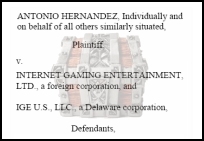
Hernandez v. IGE CaptionLast month, Hernandez v. IGE defendant IGE filed a motion (.pdf, via Justia) to stay the case in favor of arbitration, or dismiss it in favor of jurisdiction in California. Hernandez recently responded, arguing the Florida court should keep the case (.pdf, via Justia).

Brief recap: Plaintiff (on behalf of essentially all World of Warcraft players) is suing virtual property dealer IGE as as “third party beneficiary” of the Terms of Use that IGE had to agree to in order to use World of Warcraft. Plaintiff’s argument is that by devaluing gold, spamming chat, camping spawns, and generally disrupting gameplay, IGE has broken its agreement with Blizzard and injured all other World of Warcraft players — the “intended beneficiaries” of that agreement. It is a novel application of the “third party beneficiary” doctrine, but it is plausible, and could pave the way for similar claims in other virtual worlds and games.

Here, the argument is over whether the clause requiring arbitration should apply to this kind of third-party beneficiary action. Because this case involves a relatively unconventional use of the third party beneficiary doctrine, there is no case law directly on point. As a result, the parties are arguing somewhat differently than they would in a typical argument over an arbitration clause.

IGE argues that in traditional third party beneficiary proceedings, all the terms of the contract apply, and that should be true here too. Hernandez argues that the impact of the application of this clause in this situation would be to deny any possibility of a class-based claim against another player, because class-based arbitrations are prohibited by the clause. He also argues his claims aren’t the sort covered by the agreement, and that at least one claim — where he is seeking an injunction stopping IGE’s gold farming — is expressly exempted from the arbitration clause.

It would be a significant setback for the lawsuit if the court stays proceedings.

As always when reviewing excerpts from court filings on VB, keep in mind that a brief is an advocacy document, and thus intentionally slanted in favor of the party that files it (here, Hernandez). Here are a few key excerpts:

Notwithstanding the irony and inequity of IGE US’ position that Plaintiffs are bound by the EULA and TOA but it is not, IGE US’ Motion should be denied for the following reasons:

(1) The claims included within Plaintiffs’ Amended Class Action Complaint are expressly excluded from the arbitration clause contained in the EULA and TOU;

(2) IGE US has not conceded or properly established the validity of the arbitration clause included within the EULA and TOU;

(3) Plaintiffs’ Statutory Consumer and computer fraud claims must be decided by this Court to afford Plaintiffs the meaningful relief these statutes provide;

(4) Plaintiffs’ class claims are not arbitrable because Plaintiffs’ agreement with Blizzard Entertainment cannot be construed as a waiver of Plaintiffs’ right to prosecute class action claims against an entity, like IGE US, who violates the terms of the EULA or TOU;

(5) Plaintiffs’ forum selection clause with Blizzard does not apply to Plaintiffs’ dispute with IGE US.

Read the rest of the post »

Email This Post Email This Post
Print This Post (Printer Friendly Formatting) Print This Post (Printer Friendly Formatting)


Related Posts on Virtually Blind

The Associated Press reports that Japanese researchers are hard at work on new ways for users to interact with virtual worlds such as Second Life. Some of these raise the possibility of long-distance assault and battery claims.

One technology involves a user moving across a large mat with specially coded patterns on it. As the user moves across the mat, the system tracks all movements and reflects them in the on-screen avatar. Not simply limited to the basic “forward, backward, left, right,” the system can also process vertical distance and tilt. To demonstrate this ability, the researcher crouched down on the mat to peer under a virtual parked car. Accordingly, the on-screen image swerved to show what the avatar would “see” — the vehicle’s underside.

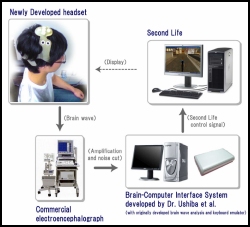
Second Life Brain InterfaceAnother technology monitors brain activity (.pdf, via Keio University), so players can make their avatars move just by thinking of commands like forward, right or left. The interface uses electrodes attached to the user’s scalp to sense activity in the brain’s sensory-motor cortex. The brain activity is then translated into signals that control the avatar.

When these technologies, particularly the first, are eventually paired with “force feedback” devices, such as a recently released vest which lets users “get pounded with body slams, crushed with G-forces, and blasted with bullet fire,” science fiction questions of real-life battery (requiring contact) arising from virtual world interactions move a bit closer to reality.

While interesting, it’s unlikely that these new interfaces will replace the mouse and keyboard anytime soon. After all, virtual worlds are about much more than movement. A user needs to be able to interact with objects and communicate with others. Combine these technologies with voice recognition software and they may be on to something. (Of course, good luck making space for that mat system in the typical San Francisco flat.)

From a health perspective, I do applaud any idea that gets users up off their seats and burning calories walking around the room. On the other hand, the brain interface makes even those pesky hand movements unnecessary. Quite a coup for the lazy gamer.

On a final note, they’d better do a lot more testing before this blogger straps any sort of electrode to his scalp!

Kenan Farrell is an intellectual property attorney who recently moved to San Francisco from Indianapolis. He is a member of the U.S. Patent Bar and past chairman of the Indianapolis Bar Association’s Intellectual Property Executive Board.

Email This Post Email This Post
Print This Post (Printer Friendly Formatting) Print This Post (Printer Friendly Formatting)


Related Posts on Virtually Blind

A recent tragic death that was allegedly sparked by a series of MySpace messages from a phony account suggests the possible application of a neglected tort called “Intentional Infliction of Emotional Distress” to virtual worlds. While MySpace isn’t really a virtual world, the connections there (between people using pseudoanonymous identities) mirror virtual world activity, and the legal questions this issues raises are no different.

MySpace LogoAccording to a report last in the St. Charles Journal, a thirteen-year-old Missouri girl named Megan Meier recently took her own life after a MySpace “friend” — a “really hot” guitar-playing sixteen-year-old named Josh Evans she regularly chatted with — allegedly told her that everyone in her hometown hated her, and that the world would be better off without her.

If that was all there was to the story, it would be tragic, but sadly, not overwhelmingly uncommon. It actually gets much worse.

According to Megan’s parents, Josh Evans did not exist. They believe that the “Josh Evans” account was the fabrication of the parents of a former friend of Megan’s with whom Megan had a falling out. According to the article, several of Megan’s peers had the password to the account, including one girl Megan’s age who had sent a message from the account the night before Megan died. This girl, through her mother, told the Meiers that their adult neighbors had created the account and encouraged her and other children to send Megan increasingly hostile messages.

It’s important to note that none of this has been substantiated, and that that St. Charles Journal report really leaves more questions unanswered than it answers. A Wired blogger reports that a prosecutor is reviewing the case.

From the standpoint of virtual law, the allegations here highlight a potential application for the doctrine of “Intentional Infliction of Emotional Distress” (IIED). The tort, which has gained limited acceptance since it first appeared in California in the middle of the last century, may find renewed life in lawsuits arising from similar conduct in virtual worlds.

The problem, traditionally, with bringing a claim based on IIED that the bar for judging the behavior that gives rise to the claim is pretty high. People just aren’t that awful to each other face to face, for the most part. Unfortunately, the pseudoanonymity offered in virtual worlds and on sites like MySpace encourages behavior that regularly meets the test.

Read the rest of the post »

Email This Post Email This Post
Print This Post (Printer Friendly Formatting) Print This Post (Printer Friendly Formatting)


Related Posts on Virtually Blind

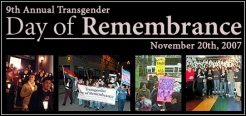
Transgender Day of RememberanceNovember 20, 2007 marks a Day of Remembrance to memorialize those who have lost their lives due to anti-transgender hatred or prejudice. The event is held each November to honor Rita Hester, whose 1998 murder sparked the “Remembering Our Dead” web project and a San Francisco candlelight vigil in 1999. As part of the Day of Remembrance, the legal “blog carnival” Blawg Review is focused on transgender workplace diversity this week. The event will also be marked in Second Life with a 24-hour memorial at Elysium Gardens (SLURL).

From the announcement of the in-world event (via SL Pulse):

On Tuesday, November 20th, Elysium Gardens, with the support of the Transgender Resource Center, will host Second Life’s first service held in memory of victims of violence directed against the transgendered. Unlike traditional Transgender Day of Remembrance services, the Elysium Gardens service will be observed as an all-day event running from midnight to midnight (PST) and is designed to offer residents of Second Life from around the world access to a beautiful yet solemn location to honor victims of anti-transgender violence. Also unlike traditional Transgender Day of Remembrance services, Elysium Gardens will use this unique opportunity and medium to honor victims of a different kind of violence–the prejudice that leads many transgendered individuals to end their own lives.

Thanks to the editor of Blawg Review for the heads’ up, and to SL Pulse for the announcement regarding the in-world event.

Email This Post Email This Post
Print This Post (Printer Friendly Formatting) Print This Post (Printer Friendly Formatting)


Related Posts on Virtually Blind


Page 45 of 87« First...«4344454647»...Last »