Subscribe to
Posts
Comments

Harvard Extension Class Second LifeThe Harvard Extension School is running a course focused on virtual law with a Second Life component. Rebecca Nesson (‘Rebecca Berkman’ in Second Life) is teaching the class. The lectures, which look fascinating, are available to at-large participants on Berkman Island (SLURL).

You can attend the lectures in Second Life on Monday evenings from 8:00-10:00pm EST (5:00-7:00pm SL time). Videos of past lectures are linked on the course’s web site, where you can also find the syllabus, a wiki, and more. The next class is on Monday, November 19th, and is entitled “The Boundaries of Code — Governance, and Law in Virtual Worlds.”

From the description for the November 19th class:

Now that we’ve all been convinced of the power of code to shape our environment, we examine the boundaries of that power. Today we’ll consider actions in virtual worlds that cannot easily be regulated by code even for those who are in control of the code as well as the questions of what input residents of virtual worlds should have into the control of the code itself.

Sadly, I missed the announcement for this when it started, and the class is now well underway. Better late than never. The class looks great, and I suspect many regular VB readers will want to attend the remaining lectures.

Email This Post Email This Post
Print This Post (Printer Friendly Formatting) Print This Post (Printer Friendly Formatting)


Related Posts on Virtually Blind

Habbo LogoReuters UK is reporting that Dutch police have arrested a seventeen-year-old Habbo Hotel user for the theft of almost $6000 worth of virtual furniture from other users of Habbo Hotel, a virtual world for teens.

An Amsterdam police spokeswoman confirmed a report that the teenager was accused of stealing 4,000 euros (2,844 pounds) [$5857 US] worth of virtual furniture by hacking into the accounts of other users.

Four other 15-year-olds have also been questioned in the case, which was instigated by the Web site. They are suspected of moving the stolen furniture into their own online hotel rooms.

Habbo does not have an active currency exchange and discourages RMT, but does sell “coins” for about $0.20 each, which can be used to purchase virtual furniture and items (some are expensive rares), and play online games.

Commentary

Habbo Hotel Room

A few things jump out here. First, for better or worse, more and more countries are taking virtual property seriously, even in closed worlds that do not acknowledge RMT. It’s just a matter of time before this happens in the U.S., and it is starting to look like the U.S. is falling behind. There must be “magic circle” protection for spaces that make an effort to remain play spaces, but when companies are exchanging real money for tokens, furniture, custom avatars, and the rest — sometimes a lot of money — the law has to recognize that the result of the transactions have real value.

Second, Sulake Corporation apparently got involved themselves — the case was “instigated by the web site” according to Reuters. Two years ago, I’d have bet on 10 comments against them for it. Now? I suspect they’ll be mixed, at most. I think virtual world users are finding they appreciate a little hands-on governance when it comes to theft, gold farming, griefing, hacking, and all the rest of what makes virtual worlds and games less fun. Personally, as far as I’m concerned, good for Sulake; this is a seventeen-year-old who allegedly stole almost $6000 worth of other kids’ — mostly younger kids’ — allowance money. Seems a fine place to draw a line.

And finally, RMT reality check. Six grand? In a virtual world for teens? How is that even possible? How much can this stuff be worth on a per-item basis, and how much pixelated junk can you fit in a Habbo Hotel room anyway?

Email This Post Email This Post
Print This Post (Printer Friendly Formatting) Print This Post (Printer Friendly Formatting)


Related Posts on Virtually Blind

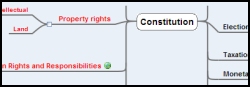
Metaverse Constution MindmapA new blog/wiki/project called “A Constitution for the Metaverse” just hit my radar screen, and I’m going to be watching to see where it goes.

The Metaverse Constitution appears, at this point, to be essentially a one person effort, but an eventual wiki is planned. The project is part of Harvard Master of Laws (LL.M.) student Doug McMahon’s “long paper.” There are just a few posts now, but they’re intriguing, particularly McMahon’s “mindmap” of the project.

One odd wrinkle, McMahon says he’s not an active Second Life user (and presumably he doesn’t use any of the other virtual world platforms regularly either). He says he’ll explain why he’s not involved later, and invites readers to convince him that he should be.

From McMahon’s “Why?” post:

The question of why I would seek to draft a constitution for the metaverse, and why I think it might need one, is an obvious one. I genuinely believe that any online world in which users seek some kind of autonomy from the real world cannot function satisfactorily without one. To this you might reply that Second Life, the leading metaverse, seems to be doing just fine. But I would question whether the benevolent dictator model for metaverses is really sustainable. All the power in Second Life is concentrated in the hands of Linden Labs, they are the archetypal judge, jury and executioner with the added twist that they are also the law makers and the executive in the world.

Email This Post Email This Post
Print This Post (Printer Friendly Formatting) Print This Post (Printer Friendly Formatting)


Related Posts on Virtually Blind

Hernandez v. IGE CaptionEarlier this year, a class action lawsuit was filed in the Southern District of Florida on behalf of nearly every World of Warcraft (“WoW”) player, naming one of the largest virtual property companies, Internet Gaming Entertainment (“IGE”), as defendant. WoW player Antonio Hernandez is named plaintiff. The class has not yet been certified.

Plaintiffs’ core claims read as if they come straight out of Richard Bartle’s Pitfalls of Virtual Property (.pdf). Plaintiffs allege that IGE, by running a gold farming operation, camping spawns, devaluing gold, spamming chat, and generally making gameplay less satisfying, has intentionally breached the World of Warcraft Terms of Use (“ToU”) and End User License Agreement (“EULA”). IGE’s employees must, of course, agree to the ToU and EULA in order to use World of Warcraft to accumulate and transfer WoW gold and other virtual property, and to level WoW accounts for sale. The complaint alleges that the plaintiffs were intended “third party beneficiaries” of the ToU and EULA between IGE and Blizzard, and suffered harm as a result of IGE’s breach of these agreements. The amended complaint is here (.pdf, via Justia).

IGE LogoGenerally, third-party beneficiary contract claims are hard to win because the third-party (here, your average World of Warcarft player) has to be the “intended beneficiary” (as opposed to the “incidental beneficiary”) of the contract, and many standard contracts include language stating that there are no third-party beneficiaries. However, the World of Warcraft Terms of Use and EULA, somewhat surprisingly, do not include such a provision. Moreover, Blizzard has publicly stated that it supports the goals of the lawsuit, which implies that Blizzard might be willing to file a declaration to the effect that plaintiffs were the intended beneficiaries of at least the contract provisions prohibiting gold farming, when and if a motion is eventually filed on those grounds. The suit has widespread support from players in the official forums.

Not much has happened in the case up to now, but since motion practice is starting to heat up and class certification is potentially on the horizon, VB will begin paying closer attention to filings.

As we kick off coverage of another lawsuit, please keep two things in mind. First, understand that for professional reasons, VB doesn’t comment on active filings, though we do run key excerpts and point out things that are so anomalous that most litigators would notice them. And second, remember that the filings, because they’re advocacy documents, tend to put everything in a light most favorable to the party that filed them.

The most recent filing in this case is a motion (.pdf via Justia) to stay the case in favor of arbitration, allegedly as required by defendant’s contracts with Blizzard (of which plaintiffs say they were the intended beneficiaries). In the alternate, defendants ask that the case be dismissed in favor of jurisdiction in California. A response was supposed to be filed by now, but plaintiffs received a fairly routine, unopposed, ten-day extension of time to respond. VB will run excerpts from the response as soon as it is filed.

Excerpts from Defendant’s motion to stay or dismiss the case follow.

Read the rest of the post »

Email This Post Email This Post
Print This Post (Printer Friendly Formatting) Print This Post (Printer Friendly Formatting)


Related Posts on Virtually Blind


Page 46 of 87« First...«4445464748»...Last »