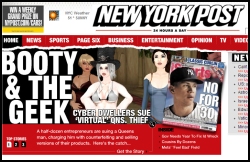
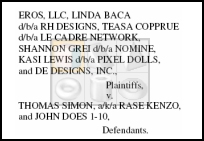
 Six major Second Life content creators have filed a lawsuit (.pdf) in the Eastern District of New York claiming copyright and trademark infringement against Second Life user Thomas Simon of New York, who allegedly exploited a flaw in the Second Life software to duplicate thousands of copies of the creators’ products.
Simon allegedly sold copies of the creators products to other Second Life users as Second Life avatar ‘Rase Kenzo.’
The allegedly infringing items represent nearly every type of product for sale in Second Life including avatar clothing, skins and shapes, scripted objects, furniture, and more. All of the products allegedly duplicated appear to be covered by plaintiffs’ copyrights and trademarks.
Plaintiffs claim that Thomas Simon, a Flushing, NY resident, used and continues to use the ‘Rase Kenzo’ avatar to duplicate and sell unauthorized copies of the plaintiffs’ products, mainly through scripted in-world JEVN vendors, avatar-to-avatar transactions, and virtual “yard sales.”
This guy cherry-picked from every major designer in Second Life, and then duplicated all of it over and over and over.
One of the six plaintiffs is Eros, LLC. Eros’ CEO is ‘Stroker Serpentine’ (Kevin Alderman in real life). Eros brought a similar suit against a John Doe defendant earlier this year. The other five plaintiffs are also well known Second Life content creators. They are DE Designs, Inc. (‘DoC Eldritch’ in Second Life), RH Designs (‘Rebel Hope’ in-world), Le Cadre (‘Asri Falcone’), Nomine (‘Munchflower Zaius’), and Pixel Dolls (‘Nephilaine Protagonist’).
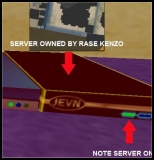 Over 150 screenshots showing alleged copies of the creators’ products placed in activated vendors (allegedly for sale) and boxes (allegedly for duplication) owned by ‘Kenzo’ are available via an anonymous Flickr album. The album has been the subject of intense speculation in the Second Life blogosphere since it appeared three weeks ago. It is directly referenced in the complaint, and appears to have been created for this litigation.
“If you look at the pictures [on Flickr] you can see boxes and boxes of this stuff,” Alderman said. “This guy cherry-picked from every major designer in Second Life, and then duplicated all of it over and over and over the same way. He has thousands of these items.”
According to Alderman, many of the allegedly infringing products were originally marked “no copy” and “no transfer,” meaning that it is theoretically impossible to replicate or sell them in Second Life.
Alderman said that he believes Simon took advantage of a fairly well known Second Life security flaw that allows user to make unauthorized duplicates of items by moving the objects from their inventory to the world (causing them to be registered on the server) during times of heavy lag or, in a related exploit, immediately before a server crashes or is rolled back. When the server catches up to the requests, duplicate items are created.
We sent a cease and desist letter and a settlement proposal, and the nature of the response established that this guy controls the ‘Rase Kenzo’ avatar.
Each of the creators is identified in the complaint with a real name. Though all except ‘Hope’ have previously made their identities known, the creators are aware that this suit will invite greater scrutiny into their real lives. “Unfortunately, that’s part of this,” said Alderman, “because legal action is our only real choice, we end up having to give up some of our own privacy.”
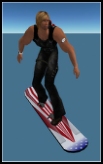 The alleged association between defendant Thomas Simon and the ‘Kenzo’ avatar (left, skysurfing in his Second Life profile picture) appears conclusive. Frank Taney, a partner with Buchanan Ingersoll & Rooney who represents the plaintiffs in this case, said that it was not necessary to bring a complaint against a fictitious defendant in this case because a combination of real world and in-world communication with Thomas Simon pre-filing established that Simon controlled the ‘Rase Kenzo’ Second Life account.
“We sent [Simon] a cease and desist letter and a settlement proposal,” Taney said, “and the nature of the response established that this guy controls the ‘Rase Kenzo’ avatar.” Besides Simon, ten fictitious defendants are also named as part of a civil conspiracy. This makes it easier for the plaintiffs to add additional named defendants if discovery reveals potential co-conspirators.
We originally tried to go through Linden Lab. Everybody filed DMCA notices. We filed support tickets and abuse reports. We even sent a letter to Robin and copied Philip. We got nothing.
Alderman said the lawsuit follows over six weeks of fruitless negotiation. “We had hoped to resolve this without filing a suit, but that hasn’t happened.”
Plaintiffs, who have managed to keep the potential lawsuit extraordinarily quiet given the scrutiny of the Second Life blogosphere, were apparently hoping that Simon would want to preserve the reputation of his avatar. “The guy has been on the grid for two years, and he ran a DJ business,” said Alderman. “He’s pretty well known.” Alderman said that the Plaintiffs recently offered that if Simon would cease his allegedly infringing activity, surrender his inventory of allegedly duplicated goods, and covers the plaintiffs’ expenses, plaintiffs would not file the suit, “and he basically told us to take a flying leap.”
Read the rest of the post »
 Brooklyn Law Review just published a student note on defamation in virtual worlds that is worth reading. The author is Bettina Chin. I should have run this a couple of weeks ago, but it slipped through somehow. Hat tip to Greg Lastowka over at VB’s more studious neighbor, Terra Nova, for catching it as part of his regular virtual law update. I don’t agree with every one of Ms. Chin’s conclusions, but her analysis is sound, the article is very readable, and she raises interesting points. One highlight: “[I]n order to bring a justiciable claim of defamation to a real-world court, the Second Life plaintiff must be able to prove that defamation of her avatar is equivalent to defamation of herself.”


 Some people seem to think that anonymity gives them the right to steal, as we’ve seen with the World Wide Web. I’m a Second Life content creator myself, and good friends with many: some attended my real-life wedding, and I’m married to a Second Life clothing designer.