Subscribe to
Posts
Comments

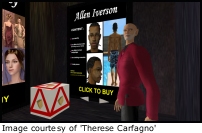
'Like a Celebrity' Store Image Courtesy of 'Therese Carfagno'The Second Life News Network is running a short piece on another scam in Second Life. This time it’s someone allegedly selling empty boxes labeled as celebrity skins via an in-world store called “Like a Celebrity.”

The alleged scammer used the avatar ‘Brenda Balczo’ (‘Balczo’ did not respond to a request for an interview). The store has been closed, and the vendors taken down. ‘Therese Carfagno,’ who wrote the SLNN piece, took the accompanying picture earlier, and graciously gave permission for its use.

From the Second Life News Network article:

‘Ey Ren’ is among those who feel cheated. ”I thought I’d bought a Legolas shape. But alas, the box was empty,” ‘Ren’ said. (Legolas is an elf character in J.R.R. Tolkien’s series, Lord of the Rings.)

Besides the skin representing the iconic stair-surfing elf, the store also carried skins (well, empty boxes purporting to contain skins) based on Angelina Jolie, Brad Pitt, Allen Iverson, and other real life celebrities.

The irony here is that though IP infringement is far more widespread than fraud in Second Life, this particular alleged scammer actually avoided infringing MGM’s copyright, and Jolie’s, Pitt’s and Iverson’s rights of publicity, at the same time that she was defrauding her customers.

I guess it’s hard to be a tiny criminal mastermind without managing to do at least something right.

Email This Post Email This Post
Print This Post (Printer Friendly Formatting) Print This Post (Printer Friendly Formatting)


Related Posts on Virtually Blind

Virtually Blind periodically features “Three Things” — quick lists of places, people, or issues important to virtual law. Because there are so many first-time visitors to the site this weekend (VB was linked in Regina Lynn’s “Sex Drive” column on Wired yesterday) I want to provide a quick overview of virtual law for our new readers. So though it’s a bit of a retread for regulars, here’s an update on the three top legal issues facing virtual worlds.

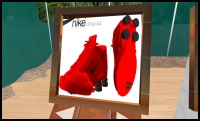
Knock-off 'Nike' Shox in Second LifeTrademark Issues - VB covered this extensively yesterday (summary: there’s an awful lot of trademark infringement in Second Life). The post has accumulated some exceptionally well-reasoned comments from readers who come down on both sides of the issue. Some think it’s no big deal since most of the companies in question aren’t in the virtual world yet anyway, others agree with me that we’re close to a crisis point, and one (‘Lourdes’) makes the excellent point that companies who are looking into this should find a way to work with infringers rather than immediately releasing the hounds, er, lawyers.

Video Store with Current Hit Movies in Second LifeCopyright Issues - Close on the heels of the trademark problem in the race to see which draws a lawsuit first is widespread copyright infringement in Second Life. Everything from unauthorized copies of sexually explicit scifi novels, to unlicensed streaming music, to a simulated Wizard’s Alley lifted straight from the Harry Potter books, to hit movie downloads (see image), is available in Second Life. In terms of sheer volume, copyright infringement likely outweighs trademark, but I suspect trademark issues will attract the interest of huge companies with lots of attorneys before Hollywood and the RIAA start paying attention to virtual worlds.
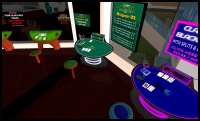
Casino, er, 'Kasino' in Second LifeGambling – Last month, it was widely reported that the FBI visited Second Life’s “simulated casinos.” (Just what, exactly, is “simulated” about playing blackjack for a currency that can be instantly redeemed for U.S. dollars, you may ask? Well, nothing, really, according to two law professors, though that’s still the subject of some debate.) The feebies were just visiting mind you — Linden Lab went to some effort to make it clear that in spite of reports to the contrary, they knew of “no law enforcement agency that has opened an investigation.” After the visit, however, Linden Lab changed its advertising policy, prohibiting ads “that appear to relate to simulated casino activity.” It took a while for the change to have any impact (VB reported finding hundreds of ads when searching for “Casino” two weeks after the change was announced). But now, if you search for the word “Casino” in-world, you find absolutely nothing. In an unrelated story, a new game called “Kasino” appears to be taking the grid by storm.

Email This Post Email This Post
Print This Post (Printer Friendly Formatting) Print This Post (Printer Friendly Formatting)


Related Posts on Virtually Blind

The dirtiest little legal secret in Second Life isn’t virtual escorts, illegal gambling, ponzi schemes, or even money laundering — the secret is this: misappropriation of major corporations’ trademarks in Second Life is so ubiquitous, so safe, and so immensely profitable, that it has become a wholly transparent part of Second Life’s bustling commercial landscape.

Here are a handful of numbers gathered May 4, 2007, that begin to illuminate the scope of the problem:

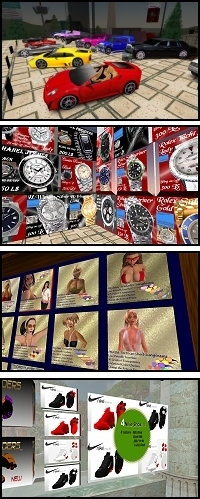
  • There are at least 16 shops in Second Life advertising “Ferrari” cars. One model sells for L$1995 (approximately US $7.75). Ferrari does not have an official presence in Second Life.
  • At least 40 stores in Second Life advertise virtual “Rolex” and “Chanel” watches, averaging around L$350 (US $1.61). Neither Rolex nor Chanel runs any of these stores.
  • Ferarri Rolex Chanel Gucci Rayban Oakley Prada and Nike Knock-Offs in Second LifeThere are more than 50 stores in Second Life carrying virtual sunglasses branded “Gucci,” “Prada,” “Rayban,” and “Oakley.” Each pair is priced around L$125 (US $0.75). None of these stores appears to be owned, sponsored, endorsed, or licensed by any of these companies.
  • The term “Gucci” alone generates 106 hits in Second Life classifieds, referring shoppers to stores selling virtual versions of nearly every hot product the company makes, including shoes, handbags, and clothing. “Vuitton” generates 39 hits. “Abercrombie” gets 30. “Timberland” gets 26. None of these stores appear to be affiliated with the company behind the name.
  • “Nike” holds the record, generating 186 hits, many of which link to stores where shoppers can find avatar shoes bearing the company’s distinctive swoosh. Nike itself does not sell any of these shoes.
  • Even geek-darling Apple isn’t immune. A half-dozen stores in Second Life sell virtual “iPods” for avatars. Some add copyright infringement, preloading the unlicensed “iPods” with songs from artists ranging from Michael Jackson to Gwen Stefani. Apple is not behind these stores.
  • Of ten randomly selected “shopping malls” found in Second Life’s classifieds, seven had stores selling goods that exhibited obvious trademark infringement. Several stores VB visited for this piece appeared to sell nothing but unlicensed brand-name goods.

This past March, about 11,500,000 transactions took place within Second Life. There’s no way to know exactly how many involved knock-off goods, but a quick overview of in-world shopping areas reveals that well over 1% (probably closer to 3-5%) of the goods for sale in-world carry unlicensed trademarks. For the sake of argument, let’s be conservative and say that about 1% of the transactions in-world involve unlicensed trademarks. That’s about 115,000 instances of profitable, in-world trademark infringement in March, 2007, alone. Projected out, around 1.4 million transactions a year.

Using an average transaction value of $1.50 (less than the current, saturated-market price of a knock-off Rolex) we’re in the range of US $2m in transactions involving counterfeit goods in Second Life every year. That’s quite a bit of money, but it isn’t that much that any individual business is leaving on the table. At least not yet. So why should a company care, right now?

Two reasons — one is legal, and the other is practical.

Read the rest of the post »

Email This Post Email This Post
Print This Post (Printer Friendly Formatting) Print This Post (Printer Friendly Formatting)


Related Posts on Virtually Blind

Second Life Insider has a short piece up this morning on business attire in virtual worlds. That piece links to this Information Week Blog post by Mitch Wagner, which is the most interesting thing I’ve read recently on avatar customization.

The point of the SLI post is basically that people should make their avatars look however they want, and not view virtual worlds as requiring the same attire as real life. The author, ‘Akela Talamasca,’ writes, “I’m more interested in what people have to say than in how they look, and in fact find a lack of creativity in one’s avatar an indication of some aspect of one’s personality.”

I generally like that analysis, though I think it makes more sense about avatars that are being used for play. Regarding business wear, I think there’s a good argument for traditional business attire in traditional business settings — even in virtual worlds — that the SLI post overlooks.

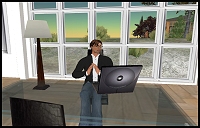
Benjamin Duranske's SL Avatar 'Benjamin Noble' at his DeskMy take: a lot of people who are new to doing business in virtual worlds are pretty freaked out by what they find. In my experience, it helps put them at ease if I log on looking the same way I’d look if I were to meet them in the real world.
Coincidentally, I’m writing this sitting in a coffee shop (in the real world) waiting to meet a couple of venture capital guys to talk about virtual worlds. They’re looking at a company with some tangential virtual world ties, and they want an introduction to the space.

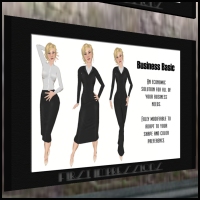
Women's Business Clothing in Second Life at IndustriElleIn real life, I’m wearing a blue blazer, a pair of jeans, an open-neck light blue dress shirt, and black-frame glasses. And when I log on to Second Life to show them around, my avatar (‘Benjamin Noble’) will be wearing almost exactly the same thing. In fact, the only difference is that his shirt is white.
That is not by chance. I’m not sure if these guys have ever logged on to a virtual world before, but they may well not have. They are going to see avatars that appear to be theme-park mascots, leather-clad vampires, and underage strippers. I like my avatar to provide some perspective.

In other words, putting ‘Benjamin Noble’ in a traditional blue blazer and making him look like I do in real life gives business people I interact with something that they recognize, and it also sends the message that not everyone views this as Disneyland or Amsterdam’s red light district.

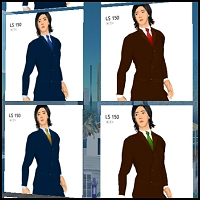
Men's Business Clothing in Second Life at LINDMANNYeah, it means my avatar doesn’t really express my creative side, but I can always create another one if I want to join a roleplaying community or do something where creativity is more important than business credibility. And I think there’s a certain amount of creativity involved in making my avatar as realistic as I can too.

(Now that I think about it, ‘Benjamin Noble’ is due for an upgrade. I’ve seen some fantastically photorealistic skins and really well sculpted shapes recently, and I want one that looks as much like the real-world me as possible. Besides, my mother saw my avatar’s picture on this blog at one point and said, shaking her head, “He doesn’t look like you, he has a rat face.” That causes a little concern. I mean, I have an avatar even a mother can’t love? But I digress.)

I think business attire has its place in virtual worlds, but I know some readers have really creative avatars and outfit them all sorts of ways, even for business meetings, so I’m making this a “Reader Roundtable” feature, and I’m specifically inviting everyone to comment.

What does your avatar look like for business, and why?

Email This Post Email This Post
Print This Post (Printer Friendly Formatting) Print This Post (Printer Friendly Formatting)


Related Posts on Virtually Blind


Page 76 of 87« First...«7475767778»...Last »