Subscribe to
Posts
Comments

Virtually Blind periodically runs “quicklinks” — items that are not long enough for a full story, but are worth a click. Here’s today’s batch:

  • Kan Suzuki's Second Life OfficeIn a good example of how virtual worlds are pushing the legal envelope worldwide, the BBC is reporting that a “Japanese politician has become the first of the nation’s lawmakers to open a cyber office on the internet-based virtual world Second Life.” The politician is Kan Suzuki, who is seeking re-election in the upper house in July. The BBC reports that there is concern that the office violates a 50 year-old Japanese election law that “limits the distribution of text and images for use in election campaigns to postcards and pamphlets.” Here’s a SLURL to the office.
  • VB will likely be covering this one in greater depth at some point, but for now, it’s at least worth putting on your radar screen that there’s been a lawsuit filed in Florida regarding World of Warcraft gold farming that doesn’t involve publisher Blizzard. The lawsuit has been styled as a class action, and the plaintiffs are suing IGE, a gold farming company, for the usual dozen or so counts that get tossed in complaints like these: unfair trade practices, conspiracy, breach of third party beneficiary contract, tortuous interference with a business relationship, and a handful of others. It basically boils down to the fact that gold farming messes up the in world economy, making it less fun to play WoW.

  • Sweden's Second Life EmbassyBack to the international desk, CNN reports that Sweden has followed through on its earlier pledge to open a Second Life embassy. CNN quotes the Swedish Institute: “The embassy is now open to the public and offers a smorgasbord of impressions to anyone interested in Sweden.” Legally, the “embassy” isn’t really an embassy in any traditional sense, it’s more like a tourist information center, but I couldn’t pass up the opportunity to quote a press release that uses the word “smorgasbord.” Here’s a SLURL.
  • Finally, over at Clickable Culture, Tony Walsh posts that he recently spent a little quality time with the Terms of Service for virtual world/anime forums/whatever-it-is Gaia Online. He declares them among “the fairest [he's] seen” and better than Second Life’s from the standpoint of their “grabbiness.” I haven’t visited Gaia Online yet, but it’s now on my list.

Email This Post Email This Post
Print This Post (Printer Friendly Formatting) Print This Post (Printer Friendly Formatting)


Related Posts on Virtually Blind

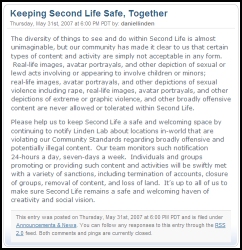
Linden Lab’s ‘Daniel Linden’ recently posted a statement entitled “Keeping Second Life Safe, Together” on the Official Linden Blog. The post encourages Second Life residents to report “broadly offensive” content to Linden Lab, and promises that people promoting or providing such content will be “swiftly met with a variety of sanctions, including termination of accounts, closure of groups, removal of content, and loss of land.”Keeping Second Life Safe, Together

‘Robin Linden’ says the post does not articulate a “new position,” but anyone who has used Second Life for more than a couple of months knows that it represents a significant shift away from Linden Lab’s longstanding hands-off approach to content. As a result, the post has sparked many editorials, protests (some with their own sub-controversies), and discussions.

What exactly is prohibited? “Real-life images, avatar portrayals, and other depiction of sexual or lewd acts involving or appearing to involve children or minors; real-life images, avatar portrayals, and other depictions of sexual violence including rape, real-life images, avatar portrayals, and other depictions of extreme or graphic violence, and other broadly offensive content.”

In other words, “pretty much whatever we feel like.”

I’ll add my voice to the growing chorus. This is a poorly considered, dangerously over-broad, and annoyingly opaque policy statement. It should be reversed for a number of reasons, not the least of which is that it potentially takes Linden Lab out from under the protection of Section 230 of the Communications Decency Act, and thereby exposes it to liability for Second Life users’ creations.

More on that later on. There’s this soapbox sitting here, you see, and one of the privileges of editing VB is that occasionally I get to climb up on it. You can skip to the jump if you want to bypass my rant.

Still with me? First, understand that I’m generally impressed with Linden Lab, and I generally like where they’ve taken Second Life. I’m hardly a regular critic. That said, this is the worst misstep I’ve seen them make, and I think it’s going to take quite a bit of backpedaling to fix it.

The most glaring problem with the “Keeping Second Life Safe, Together” post is that it represents, at best, a half-baked policy statement. For example, the prohibition on “extreme or graphic violence” on its face prohibits every military simulation in Second Life. ‘Robin Linden’ subsequently clarified that “extreme violence implies extreme, disgusting, beyond-the-pale imagery, such as rotten.com-style images of violent death, not videogame-style carnage,” but I don’t buy it. Does that mean that if a simulation looks like Hitman it’s okay, but if it looks like Hostel it isn’t? How is watching someone get shot in the face more acceptable than watching someone get slashed with a meat cleaver?

And “depictions of sexual violence?” What does that even mean? Would a showing of Secretary be prohibited? On its face, the policy puts every BDSM-themed area in Second Life in violation. Consider this: depictions of sexual violence are allowed in real life — using people’s actual bodies. The practice is so broadly unoffensive that there is a street fair devoted to it every year in Linden Lab’s own backyard.

But most troubling, in my opinion, is the shiny-happy-people doublespeak that’s being used to defend this move; it’s a new tactic for Linden Lab, which I’d always thought of as refreshingly honest as far as corporations go. Even the title of the post in question is deceptive — what does “safety” have to do with “offensiveness” in the first place? It gets worse. ‘Robin Linden’ defended the move during her office hour by asking, “When faced with an opportunity to create a new world where things are supposed to be better, do you think there’s a place for slavery, forced sex, and the like?” First off, I don’t think that Second Life is a “new world where things are supposed to be better,” I think it’s a three-dimensional communication tool that simulates an environment we’re familiar with, but if you want to play that game, I’ll take the question. You’re damn right there’s a place for it — just like there is in a public library, an art gallery, and a history book.

Your “new world where things are supposed to be better” should not include censorship of the expression of ideas based on what you say your citizens want to see and hear about, even if you do think it’s for our own good. Because even if you are right about this policy this time — and you emphatically are not — the next guy might decide to ban political commentary or art that criticizes religion, and your policy sets the precedent. This is political theory 101 stuff, and if you’re going to act like this is a nation, you better start there.

The absurdity of this question really can’t be overstated — Haley’s Roots could not be enacted in this “new world where things are supposed to be better,” neither could The Color Purple. Should actual slavery and actual forced sex be forbidden? Of course. And they are, by real laws in the real world; Linden Lab runs a simulation. Even if you view it as a nation of some sort — perhaps particularly if you do — the “government” should no more ban depictions of some of these things than a library should ban descriptions of them.

But my voice is just one of many who are saying this policy is a bad idea from a user-relations and political theory standpoint. There are three legal points that are being routinely overlooked in the commentary on this, so I’ll get off my soapbox and get to the law stuff.

Read the rest of the post »

Email This Post Email This Post
Print This Post (Printer Friendly Formatting) Print This Post (Printer Friendly Formatting)


Related Posts on Virtually Blind

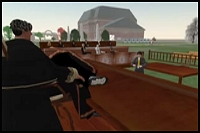
Image from HLS's Dred Scott Reenactment in Second LifeThe folks at Harvard Law School who have been running mock trials in Second Life have produced a machinima reenactment of part of the Dred Scott argument before the Supreme Court in 1856.

It’s just a proof-of-concept video, and there are some production issues (e.g. seeing the attorney who is “speaking” typing in the air is really odd) but they lined up a professional voice actor, and overall, it’s a decent first effort. It will be interesting to see what they can do if they devote more time to one of these.

Email This Post Email This Post
Print This Post (Printer Friendly Formatting) Print This Post (Printer Friendly Formatting)


Related Posts on Virtually Blind

Virtually Blind periodically runs “quicklinks” — items that are not long enough for a full story, but are worth a click. Here’s today’s batch:

  • Familles de FranceGamepolitics reports that French watchdog group Familles de France is bringing a lawsuit targeting Second Life and a number of ISP’s who provide access to it because Second Life contains, “…pornographic photos and videos in free access [areas where] users can mimic sexual acts, going as far as rape scenes, bondage, zoophilia and scatophilia.” Here’s a translation of the original article (from the site liberation.fr). It looks like there’s a real lawsuit involved, as the article mentions a June 18 hearing before the Tribunal de grande instance de Paris. It is not clear what French law is allegedly being violated.
  • According to Heise Online, the German police have confiscated child pornography from a Second Life user. The article discusses the report that aired on German TV several weeks ago highlighting child pornography in Second Life, but doesn’t draw a direct connection between the incidents.
  • Bluebird Cafe in Second LifeFinally, (and totally unrelated to virtual law, except that I got to visit the real-life venue when I was defending an expert deposition in Nashville a few years ago) the Bluebird Cafe now has a Second Life presence and is streaming live shows! Why am I so excited that I’m employing a rare exclamation mark and going this far off-topic? The Bluebird Cafe is the place to hear the best new singer-songwriters and vocalists trying out their stuff, bar none. Stars like Garth Brooks and Kathy Mattea played the Bluebird before they were famous, but it’s not all country… or at least it’s not all the kind of country you probably don’t like. Got a Second Life account? Check the schedule of live events and then check it out at this SLURL. You’ll be very happy you did.

Email This Post Email This Post
Print This Post (Printer Friendly Formatting) Print This Post (Printer Friendly Formatting)


Related Posts on Virtually Blind


Page 73 of 87« First...«7172737475»...Last »