Subscribe to
Posts
Comments

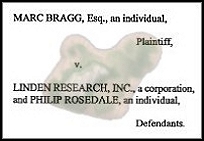
Bragg v. Linden Lab CaptionPlaintiff Marc Bragg recently filed a motion to dismiss Defendants’ counterclaims (pdf) along with a brief in support of the motion (pdf). Bragg’s motion is based on Federal Rules of Civil Procedure Rule 12. There are currently six counterclaims against Bragg in this case. They are available as part of Defendants’ Answer and Counterclaims (pdf):

  1. FEDERAL COMPUTER FRAUD, 18 U.S.C. § 1030
  2. CALIFORNIA STATUTORY COMPUTER FRAUD, CAL. PENAL CODE § 502
  3. BREACH OF CONTRACT
  4. BREACH OF THE IMPLIED COVENANT OF GOOD FAITH AND FAIR DEALING
  5. CALIFORNIA UNFAIR COMPETITION, CAL. BUS. & PROF. CODE § 17200
  6. DECLARATORY JUDGMENT

Procedurally, there’s nothing too surprising here; some variation of a Rule 12 motion, depending on the facts of the case, is typically filed at this stage in the proceedings. Substantively, however, there are some interesting claims. And stylistically, it’s certainly among the more colorful filings I’ve read.

Here’s a quick summary: we get our first detailed look at Bragg’s response to the claim that he was banned for using an exploit to buy cheap land — it appears he typed parcel numbers (for land that wasn’t yet publicized as available) into URLs for active auctions, a technique he identifies as “backward browsing.” We also get Bragg quoting Philip Rosedale sounding an awful lot like a mafia Don, and Bragg stating, “in essence, he lied,” regarding Rosedale’s comments on land ownership in Second Life.

All this and more, including the phrase, “dangerous like a cornered rat is a metaphor” (actually, it’s a simile, but it works in context), in the excerpts below.

Read the rest of the post »

Email This Post Email This Post
Print This Post (Printer Friendly Formatting) Print This Post (Printer Friendly Formatting)


Related Posts on Virtually Blind

Chinese FlagReaders with good memories will recall that about three months ago, VB ran a short piece on an odd item from the international desk. China planned to impose a new law which would require that online computer games generate half-points after three hours of play, and zero points after five hours. Games that did not comply would be shut down. Three months ago I made fun of it. Now, I’m worried about what it might mean for Second Life. It’s amazing what a child porn allegation from Germany and an ill-considered policy statement from Linden Lab can do to change one’s attitude.

According to China Daily, the law went into effect on July 17. A few interesting outtakes from the article:

The government guidelines don’t flat-out denounce Internet gaming, which has become a popular pastime, stating, “measured gaming is good for the brain, but gaming addiction hurts the body.”

The explanation says the three-hour cutoff is based on the time it takes to play a game of the strategy chess game Go.

Shanghai-based gaming company The9, which runs the popular “World of Warcraft” game in China, said on its Web site it was scheduled to launch the screening software this past Saturday at midnight. The world’s most popular online game has more than 3.5 million players in China.

This law raises questions for companies who run virtual worlds and are considering doing business in China, and it particularly raises questions about Second Life, given Linden Lab’s recent moves to force Second Life users to comply with foreign laws.

The Chinese government hasn’t zeroed in on Second Life yet. This is probably because there were just 3200 Chinese registrations as of late 2006, which in turn is because Linden Lab has not released a Chinese client. (Makes me wonder who runs this site and why Linden Lab hasn’t gotten it shut down, if it isn’t theirs. Whois doesn’t help much.) In any case, one significant news piece or spike in popularity will put it on the radar screen; the Chinese internet censors are among the most aggressive in the world. And when they do start paying attention, the first thing they will do is ask Linden Lab to help them enforce Chinese law — and particularly this law, which targets MMO platforms.

Darklife RPG Sim in Second LifeI know it sounds absurd, but it really isn’t. Remember, this is a real law that huge companies like The9 are already complying with.

Second Life doesn’t award points, of course, but there are dozens of successful in-world role-playing games that do (like, for example, Darklife, pictured). What happens to them? They aren’t going to start following this law on their own. After all, the Chinese government can’t very well shut them down. No, the issue will land in Linden Lab’s lap, and that’s where it starts to get really interesting.

Read the rest of the post »

Email This Post Email This Post
Print This Post (Printer Friendly Formatting) Print This Post (Printer Friendly Formatting)


Related Posts on Virtually Blind

World Stock Exchange LogoSeveral sites are covering a claim on the website Your2ndPlace.com that the World Stock Exchange in Second Life was hacked, and approximately $L3.2m (US$12,000) was taken.  Reuters has the most comprehensive story. [Update: Robert Bloomfield over at Metaversed has a more recently updated story up that discusses some of the fallout currently circulating.] [Update: Bloomfield has another article up, this time covering a meeting of the Second Life Exchange Commission to discuss this incident.]

Each time in-world criminal allegations like these arise, it increases the likelihood that real world regulatory bodies are going to step in. My prediction? We see a headline with both “Second Life” and “Securities Exchange Commission” in it within the year.

There is one really interesting legal question here — whether stealing Lindens from the WSE is a crime in the first place, or more like stealing from players in Ultima Online.  After all, the WSE’s head ‘LukeConnell Vendeverre’ (along with other exchange leaders) recently took the position that “the exchanges are a game,” but I’ll leave that for later.

Email This Post Email This Post
Print This Post (Printer Friendly Formatting) Print This Post (Printer Friendly Formatting)


Related Posts on Virtually Blind

The Second Life blogosphere’s always-humming soft-serve hate machine recently extruded a double cone’s worth of surprised indignation in reaction USPTO Logoto the news that “Virtual Worlds PPV,” a company owned by Timothy Allen (Second Life’s ‘FlipperPA Peregrine’) and attorney Frank Taney, had filed a patent application on an aspect of in-world pay-per-view technology.

As it turns out, the blogosphere is going to have to wait to get a legitimate shot at ‘Peregrine’ because his patent application isn’t published yet, but there are a lot of other patent applications claiming coverage of virtual world methods and technology that are already published. Some specifically address Second Life, and some of them really are broad enough that the machine ought to be able to produce indignation-surprise twisty cones all summer long.

One application I found purports to covers in-world liquidated-damages contracts. Another claims avatar-based psychiatric counseling. Another — I kid you not — claims planning and holding a meeting involving two groups.

I’ll summarize these, and a few others that struck me as interesting, below.

Read the rest of the post »

Email This Post Email This Post
Print This Post (Printer Friendly Formatting) Print This Post (Printer Friendly Formatting)


Related Posts on Virtually Blind


Page 69 of 87« First...«6768697071»...Last »