June 7th, 2008 by Benjamin Duranske
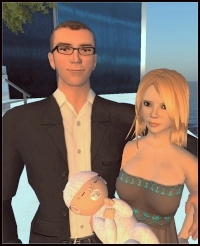 Virtually Blind will be relatively quiet for the next few weeks as my wife and I adjust to being parents. Our first child, a darling little girl we’ve named Charlotte, joined us very early this morning.
She and her mom (who made a rare virtual world appearance last week for this screenshot) are both doing great.
Of all the rotten things parents can do to a newborn, I suppose that posting a tiny, pixelated, round-headed avatar picture on a geeky law blog on the internet is right up there. So, my darling Charlotte, when you find this via search in seven or eight years, know I posted it with love and that I really do, deep down in my heart, understand that I am way less cool a dad than I think I am in my weaker moments.
VB will be back to normal in a bit. In the meantime, advice, encouragement, and ideas for automating this whole “changing” thing are welcome.
Posted in VB Administration | 28 Comments »
Related Posts on Virtually Blind
June 6th, 2008 by Benjamin Duranske
 This edition of VB’s Reading Room features a new, notable paper on virtual property by recent Columbia Law School graduate Daniel Gould. The paper is entitled Virtual Property in MMOGs (.pdf).
In the paper, Gould argues that recognition of a limited set of virtual property rights would benefit both users and virtual world companies, and sets forth both legislative and case law-based paths to that recognition.
From Virtual Property in MMOGs:
For a statutory solution, a dual sovereignty approach modeled on the Indian Civil Rights Act is advanced, in which most disputes would be adjudicated in-world. For common-law expansion with respect to virtual land in particular, it is advised to adapt a model from existing real property forms, such as a fee simple with reversion, a long-term lease, or a housing cooperative.
Gould covers the key arguments for the existence of virtual property in the first half of the paper with particular focus on the Bragg case, but it is the latter half, where he looks at various paths toward legal recognition of virtual property, that really jumps out as innovative.
The paper is a working draft, and Gould would very much appreciate constructive feedback.
On a personal note, I have to say that I’m really pleased to see that the paper footnotes the first paper hosted in VB’s Reading Room, Kevin Deenihan’s “Leave Those Orcs Alone” (now also available at SSRN). VB’s Reading Room is designed for exactly this purpose — to make new papers, particularly papers that haven’t yet been widely distributed, broadly available to the growing field of attorneys and scholars interested in virtual law. If you have a published or unpublished paper you’d like to have hosted here, drop me a note.
Posted in Property Law, Reading Room, Second Life, VB Features, Virtual Law, Virtual Legal Education, Virtual Worlds & Games | No Comments »
Related Posts on Virtually Blind
June 4th, 2008 by Benjamin Duranske
A post at SLUniverse announces that attorney Frank Taney will be talking about “Trademarks for Virtual World Related Businesses” in Second Life on Friday, June 6 from 2:30 to 4 pm Pacific time at UBM Think Services’ home (SLURL).
From the post:
Frank will address a variety of topics sure to be of interest to Second Life residents, including the use of trademarks to build value in a virtual world brand, Linden Lab’s trademark policy, proper use of trademarks, and avoidance of trademark infringement.
 Frank, a partner at Buchanan Ingersoll & Rooney, represented Eros LLC and other content creators in two “avatar v. avatar” cases last fall, and has a number of other virtual world clients. He did a Q&A earlier this year on intellectual property issues that was well attended and informative, and this promises to be a good session.
Posted in Content Creators, Eros, Second Life, Trademark Law, Virtual Law, Virtual Legal Education, Virtual Worlds & Games | 1 Comment »
Related Posts on Virtually Blind
June 3rd, 2008 by Benjamin Duranske
Last year, an ambiguous 9th Circuit ruling in Fair Housing Council v. Roommates.com muddied the waters of Section 230 immunity under the Communications Decency Act by suggesting that if a provider selects which content to allow or edits user created content, it could lose immunity for content it misses, and thus be held liable for it. A new en banc 9th Circuit ruling in Roommates.com clarifies the earlier ruling and establishes that neither a) removing objectionable content, nor b) deciding not to post certain content causes a provider to lose CDA immunity for user content that is posted.
 The original ruling raised questions for virtual world providers, particularly Linden Lab, which runs Second Life. Linden Lab was, at that time, in the middle of instituting a policy of removing certain “broadly offensive” user-created content from its world — the company’s first real attempt to regulate any aspect of Second Life. Since then, Linden Lab clarified that policy, and also took it upon itself to remove casino equipment, banking equipment, objects that allegedly infringe trademarks and copyrights, references to sexual ageplay and gambling in user profiles and place locations, the words “Lolita” and “Poker” from classified ads (regardless of context) and much more. Each of these decisions, under the previous Roommates.com ruling, potentially exposed Linden Lab to increased liability.
Linden Lab was, presumably, gambling that the 9th Circuit would ultimately clarify this ruling in favor of immunity for providers who edit and filter some content. That gamble appears to have been a good one.
Under the new ruling, providers are explicitly not held responsible for material they miss when they edit for objectionable content. This means that the gap in immunity last year’s ruling seemed to leave for providers who “edit” content has been closed, and my analysis last year that the former ruling could leave Linden Lab on the hook for editing user content to remove references to sexual ageplay is no longer a concern. Assuming they meet all the other requirements of the law, virtual world providers are not on the hook for any content they miss when they edit user profiles — and even user-owned land and objects — to remove objectionable content.
Read the rest of the post »
Posted in Commentary, Constitutional Law, Content Creators, Contract Law, Criminal Law, Lawsuits, Linden Lab, Providers, Second Life, Tort Law, VB Features, Virtual Law, Virtual Worlds & Games | No Comments »
Related Posts on Virtually Blind


