Subscribe to
Posts
Comments

I periodically dig around a bit to see what’s new in the browser-based “3D internet” realm because I think that the evolution of the internet into a 3D space is the long-term reason it makes sense to be paying attention to virtual worlds now — and it is a reason that skeptical colleagues understand. Earlier this year, I came across Smallworlds, which integrates YouTube videos, Twitter feeds, and various social networking sites into a browser-based virtual world. Today, I found ExitReality (currently in beta) which raises the stakes.

After signing up for ExitReality’s beta, downloading a browser plugin, and typing in VB’s address, I found myself walking through my own site as an avatar in a full-sized browser window. ExitReality basically makes your blog, storefront, or personal web page into a virtual world, and it does this on the fly. Cool, huh?

Here’s a big screenshot so you can see what I’m talking about without signing up for the beta and jumping through the download hoops yourself.
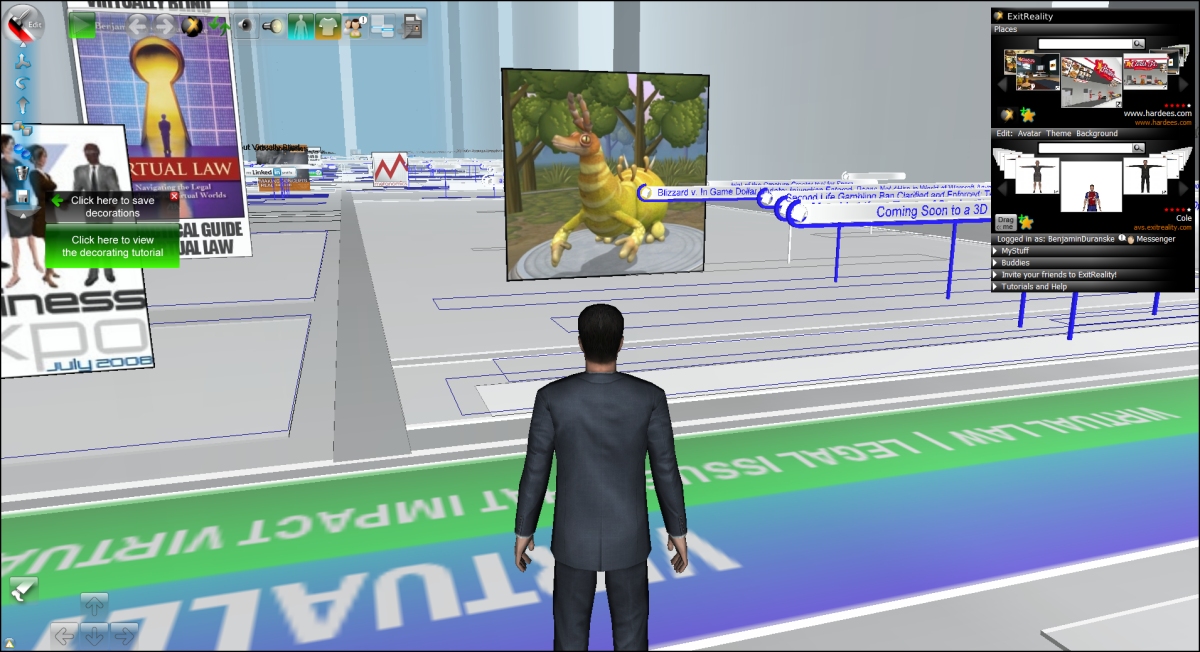
ExitReality Screenshot

You can even install couches and jukeboxes in the 3D version of your site so people can have their avatars sit down and listen to an audio stream while they chat about your articles or products or whatever in real time.

ExitReality is not perfect. It wouldn’t load when I had my laptop hooked into a big LCD monitor, it crashed a couple of times, it has a name that may alienate even more people than “Second Life” does, and most critically, because no one writes sites with 3D navigation in mind yet, navigating this way was actually less intuitive than navigating most flat sites. Who cares? I am walking around my own web site this morning, and that makes me grin.

Email This Post Email This Post
Print This Post (Printer Friendly Formatting) Print This Post (Printer Friendly Formatting)


Related Posts on Virtually Blind

This one may make your head hurt a little bit, but it highlights a problem that is coming faster than you might think. Three steps to the analysis…

Spore1) 3D games like the upcoming Spore (and, of course, free-form social environments like Second Life) let users create some pretty cool stuff. For example, I created this little guy to the right in about five minutes using the trial of the Creature Creator tool for Spore.

The ability to create cool 3D stuff is going to become more prevalent in games and virtual worlds because users now demand customization options. Even where you’d not expect it — like Madden ’08 or a racing game — a lot of players spend a lot of time customizing. Madden players create custom uniforms and accessories, and the car customization in Forza Motorsport 2 appears to trump actual play for some users. Wherever there is customization available, potential trademark and copyright infringement is fairly common — as the links above demonstrate.

2) In most games, you agree — via a clickthrough screen — that you have no ownership over the cool stuff you create. Even if you aren’t ripping off Lost or Nike (see links above) and are only doing original creations, you have to be careful about intellectual property issues. Sometimes (like in Second Life) the Terms of Service allow you to retain ownership of the intellectual property in your in-world creations. For most games, though, the Terms of Service and End User License Agreements say you own absolutely nothing.

For Spore’s “Creature Creator,” for example, you have to agree that:

EA owns all of the right, title and interest in the Spore Creature Creator, the assets included in the Creature Creator for building and animating creatures and for creating backgrounds and video clips, and all derivative works comprised of those assets, including the Spore creatures that you create, animate, and capture in screen shots or video clips using the Spore Creature Creator.

And here’s where it gets interesting…

3) We’re getting close to consumer-level 3D fabrication technology, which will let you make plastic 3D models (a.k.a. professional-grade home-made toys) based on that cool stuff you create on your computer. The technology is already reasonably priced for small businesses, and in fact, one company, Fabjectory is already selling plastic versions of Second Life avatars.

I’ve just started to wrap my head around this, but I see at least a couple of legal issues here right off the bat. The obvious one is that people are going to be able to “print” (and sell) Spore and other game creations in violation of the games’ Terms of Service and EULAs. The less obvious one is that this raises the stakes for copyright and trademark infringement in open-creation spaces — a lot. Once people are “printing” Batman and Harry Potter toys they’ve created in Second Life (rather than buying the ones DC Comics and Warner Brothers have licensed for sale at the mall) license holders will be further motivated to pay close attention to how their intellectual property is being represented in-world.

Thanks to reader C. Sven Johnson for the heads-up on this. Sven maintains the thought-provoking reBang weblog, where he covers product design, mixed reality, and lots of other cool stuff.

Email This Post Email This Post
Print This Post (Printer Friendly Formatting) Print This Post (Printer Friendly Formatting)


Related Posts on Virtually Blind

Metanomics LogoI’m pleased to announce that starting Monday, I will be appearing periodically (in avatar form) as a legal correspondent for the second season of Cornell Professor Robert Bloomfield’s excellent virtual worlds interview show, Metanomics.
My first appearance will be Monday, June 30th, at 12 noon Pacific time. I’ll be starting the hour with a brief segment on international jurisdiction, focusing particularly on the questions raised by open standards and open source platforms. The show’s featured guest will be Cisco’s Christian Renaud, who, I suspect, may also address these future possibilities from a technical/business perspective.

From the Metanomics announcement:

Christian Renaud, Chief Architect of Networked Virtual Environments for the Cisco Technology Center. Renaud announced Friday that he will be leaving Cisco. From the heart of Cisco’s incubator for emerging virtual technologies, we’ll explore Renaud’s experience, and you’ll find out why he believes that “Second Life and its walled/closed ilk will fade into the sunset in the next 24-36 months.”

Metanomics launched its second season last week with guests Rik Panganiban of Global Kids and Douglas Thomas of USC’s Annenberg School of Communication. The show takes place live each Monday in various virtual worlds (most often in Second Life). Past shows are available at SLCN.tv.

Email This Post Email This Post
Print This Post (Printer Friendly Formatting) Print This Post (Printer Friendly Formatting)


Related Posts on Virtually Blind

Hernandez v. IGE CaptionIGE has filed a brief (.pdf) in opposition to last month’s motion for class certification in Hernandez v. IGE. IGE also filed exhibits (.zip) which feature excerpts from the deposition (an out of court proceeding where someone has to answer questions under oath) of plaintiff Hernandez.

IGE’s chief argument is that Hernandez does not have standing to sue because the World of Warcraft “End User License Agreement states that World of Warcraft players ‘have no interest, monetary or otherwise, in any feature or content contained in the Game.’” IGE argues:

[T]he very agreements upon which Hernandez relies foreclose him from bringing suit. Hernandez insists that the EULA and TOU prohibit IGE U.S. from engaging in RMT, yet it is undisputable that he has no right to enforce those agreements – let alone a cognizable interest in World of Warcraft or any aspect of its game play. In short, Hernandez has not been legally injured, and has waived the right to pursue such injury in any event.

IGE also argues that the class should not be certified because it includes both gold buyers and non-gold buyers, and because different potential class members were subject to different versions of the EULA and TOS.

VB does not typically comment on active lawsuits (and notably, the following comments do not go to the general merits of this case) but I cannot resist pointing out a couple of things here.

Read the rest of the post »

Email This Post Email This Post
Print This Post (Printer Friendly Formatting) Print This Post (Printer Friendly Formatting)


Related Posts on Virtually Blind


Page 19 of 87« First...«1718192021»...Last »