SmallWorlds: A Glimpse of the Future 3D Internet?
May 22nd, 2008 by Benjamin Duranske
This is a little off topic, but I’ve found that the hardest thing to get across when you start talking about virtual worlds with people who aren’t familar with them (both lawyers and non-lawyers) is why they matter beyond their value as play spaces. My usual line is something like this: “The web is going to look a lot more like an interactive movie than a newspaper in a little while, and ‘virtual  worlds’ are just convenient shorthand for the first step.” SmallWorlds, a new project from a New Zealand web development company, could be the first two-toed tadpole in that evolutionary process.
Why will the web look more like an interactive movie than a newspaper in the not-too-distant future? First, as processing power and bandwidth increase, it will become possible to represent things in interactive 3D much more cheaply and easily (and not just via perspective-based images on a flat 2D screen… see James Cameron’s Avatar and the much-closer-than-you-think possibility of true 3D on consumer-level screens). Second, once it’s possible to cheaply and easily represent stuff in 3D, there’s just no way we’re not going to.
Really, what car company is going to be content with a picture of the new model of SUV when it can offer the opportunity to look around the interior and then climb in and drive it down a snowy mountain road? What artist will be content to show pictures of her sculptures when she can invite potential buyers to tour her sculpture garden? Sure, there will be text, just like there is in the real world. Some information is just communicated better that way — but it’s a surprisingly small amount, if you think about the real world.
Hence, networked 3D environments — also known as virtual worlds, or the 3D internet — are going to dominate how we interact online once technology allows mainstream deployment. Not as a revolutionary replacement, but just a slow progression toward first person view and experiential environments.
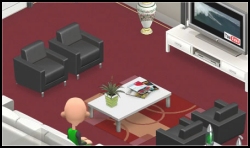 That’s a long story to get to this article from TechCrunch about a browser-based virtual world called SmallWorlds that takes a legitimate early shot at this concept (the article also offers an early ticket to the beta to the first 1000 readers to respond, with slots still open as I posted).
From the article:
SmallWorlds revolves around a characters’s room, which resembles a house one might find in The Sims. Users can furnish their rooms with TV sets that feature YouTube videos, posters of Flickr photos, Twitter messageboards, and stereos blasting tunes from Last.fm and SeeqPod. Then they can invite their friends over to their rooms, where they can view videos, photos, and songs together – a feature that will likely have mass appeal. The site facilitates meeting up with friends by assigning each room with a unique URL that will immediately transport avatars to their destination.
Yes, it’s sort of a toy still (the tagline is “Your Virtual Playground”), yes, it looks fairly cartoony, and yes, it will likely be pretty crudely implemented for now, but it is an excellent example of where I think this is going, and why, in the long run, attorneys need to be paying attention to virtual law.


Related Posts on Virtually Blind
- Reading Room: MDY v. Blizzard Copyright Issues: "This week's second installment of the Reading Room features an..." (0 comments)
- Virtual Entrepreneurs and Real Taxes: "Quick note from the road for U.S. readers who make real money in..." (1 comments)
- Justice in Ultima Online – Predictions from 1998: "Virtually Blind Commentary Back in 1998, a law professor I once met,..." (0 comments)
 Plaintiff Antonio Hernandez yesterday filed a motion seeking
  Blizzard and MDY have filed their “replies” (the last round of briefing to the court) in the
  The Second Life Herald recently
  and exercised a degree of judgment in performing their roles. These facts suggest a contractor relationship. That said, we do not know the IRS’ entire rationale in deciding that the workers were actually part-time employees.
