Subscribe to
Posts
Comments

Blawg Review LogoBlawg Review, a “blog carnival for everyone interested in law,” will be announcing the nominations for its third annual Blawg Review Awards in Second Life. The nominations will be announced at 11:00 AM Pacific (Second Life Time) on Thursday, December 27 in a live ceremony at the offices of the Second Life Bar Association (SLURL) in the new Justice Center. Virtual cappuccino and leftover holiday cookies will be served. If you are new to virtual worlds, this will be a great chance to meet other lawyers involved in this space. The awards will be announced, as usual, the last Monday of December (this year, the 31st) at Blawg Review.

What is a blog carnival? Blawg Review explains:

A blog carnival is a traveling post about a topic or theme. For example, there’s Carnival of the Capitalists, concerning business and economics, while Grand Rounds is about medicine and healthcare, and Blawg Review has topics discussed by lawyers, law students and law professors.
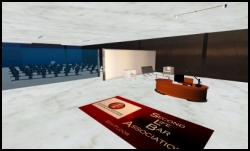
SLBA Offices in Second LifeEach week, a different law-related blog runs a special “blawg review” post on an area of law that is interesting to that blog’s editor, highlighting coverage on other legal blogs, all in the context of the host blog’s coverage. It gives lawyers, law students, and other people interested in one area of law the chance to take a guided tour of some other areas of law. Virtually Blind plans to host Blawg Review sometime in 2008, focusing on questions in virtual law and how they related to more mainstream legal issues.

Blawg Review Awards are usually fairly lighthearted — there aren’t even any banner widgets, let alone prizes. For example, the 2005 Blawg Review Award were “selected” by the Greek Goddess of Justice and Law, Themis, and accompanied by Greg Horn’s illustrations of “She-Hulk” dressed as Lady Justice (in the context of a discussion on fair use). The 2006 awards were presented “by Santa Claus to law bloggers who’ve been especially good this year.”

For more information on the Second Life Bar Association, contact VB‘s editor, Benjamin Duranske, who, as avatar ‘Benjamin Noble,’ founded the SLBA in December, 2006 and is the organization’s current President. For more information on Blawg Review, contact the Blawg Review editor.

Email This Post Email This Post
Print This Post (Printer Friendly Formatting) Print This Post (Printer Friendly Formatting)


Related Posts on Virtually Blind

A Chinese internet troll has filed a lawsuit against a news website for blocking his IP address to prevent him from commenting on its bulletin board. China Daily reports that Wang Haiyang, 60, was blacklisted last year by www.dahe.cn, a news portal belonging to Dahe Daily News Group in Henan Province, for using abusive language on the bulletin boards. The suit raises questions that will arise more often as virtual worlds gain popularity in China.

Dahe.cn Website where Wang was BannedAdministrators claim to have repeatedly warned Wang about his language and moved to block Wang late last year. However, as any dedicated troll will, Wang changed user names and reappeared on the website repeatedly. Eventually, administrators blocked all IP addresses from Wang’s community at Kaifeng Railcom. Wang wants the news company to unblock his IP address, issue a public apology and pay him 48,000 yuan ($6,400) in “spiritual compensation,” or compensation for mental suffering. Wang posted 5,664 bulletins since registering in 2004, 460 of which were deleted by administrators because of abusive language.



According to a national internet security regulation: “The use of the Internet for insulting others or fabricating facts to slander others constitutes a crime and should indicate criminal responsibility in accordance with the relevant provisions of the Criminal Law.”

Commentary

Based on the repeated abusive language , most should agree with Dahe Daily’s decision to block Wang, often a moderator has no other alternative when dealing with a persistent troll. After all, free speech doesn’t equal free language. China Daily claims this is the first time a virtual argument has led to a real lawsuit in China, and that the case is raising concerns nationwide.

In an authoritarian system, the ability to block an entire community due to the actions of one dissenting voice could lead to troubling results. Virtual worlds are increasingly popular in China, and are fertile grounds for the free-flow of ideas and innovation. But it’s hard to envision a “free” virtual world developing with regulations that define acceptable Internet uses and which do not permit users to create, replicate, retrieve or transmit certain kinds of information, such as any information:

(1) Inciting to resist or breaking the Constitution or laws or the implentation of administrative regulations;

(2) Inciting to overthrow the government or the socialist system;

(3) Inciting division of the country, harming national unification;

(4) Inciting hatred or discrimination among nationalities or harming the unity of the nationalities;

(5) Making falsehoods or distorting the truth, spreading rumors, destroying the order of society;

(6) Promoting feudal superstitions, sexually suggestive material, gambling, violence, murder;

(7) Terrorism or inciting others to criminal activity; openly insulting other people or distorting the truth to slander people;

(8) Injuring the reputation of state organs;

(9)Other activities against the Constitution, laws or administrative regulations.

Foreign companies operating in China (Google, Blizzard Activision, Linden Labs, etc.) are responsible for the editing and censoring of content and, if not managed properly, risk fines or closings. Obviously, deciding what information violates these regulations is tricky in itself — after all, what sort of language/behavior do we usually expect from a Level 24 Troll Shaman?

Private companies are being asked to make critical decisions regarding users’ actions and will likely err on the side of over-censoring to avoid punishment themselves. Even after making a determination that “unacceptable information” was shared, it shouldn’t then be appropriate to deny access to an entire community. This seems to promote, rather than nipping a rose at the bud, simply tearing out the whole bush.

Also, this blogger would be remiss not to highlight the current state of defamation law in the U.S. For background, please read the EFF’s FAQ on Online Defamation Law. Glenn Reynolds has also written an excellent paper on the topic recently, downloadable from SSRN, here. In view of China’s regulations, trolls certainly should appreciate the freedoms of the U.S. Internet.

Email This Post Email This Post
Print This Post (Printer Friendly Formatting) Print This Post (Printer Friendly Formatting)


Related Posts on Virtually Blind

Extropia LogoExtropia, an ambitious Second Life microgovernment identifying itself as an “independent technocratic city-state,” opened last month. Extropia’s designers hope it stands as an “exemplar of the future we want, today, where technology is used exuberantly in the service of beauty and fun.” Extropia is focused on creativity, offering residents an “exhilarating haven for creative expression – in architecture, social relations, sexuality, artistic and technological media.”

Extropia announced this week that it has sold out all available plots on its “Extropia Core” hub, but that it will be opening a second sim in early February, and is taking reservations for land there now. Retail space in the mall is still available. In the meantime, the board of directors at Extropia is keeping busy. Upcoming events include a party at Al Andalus (another microgovernmental project in Second Life that opened in September) to commemorate the opening of Extropia’s “embassy” there, and a December 22 Solstice celebration.

Extropia Screenshot from Above

Given the number of sometimes gorgeous but often repetitive dystopian futuristic builds, Extropia has as refreshingly upbeat feel. Picture Tomorrowland, or Gene Roddenberry’s San Francisco of the future. Extropia management completely embraces the positive future aesthetic, stating that one of the goals for the community is the “execration of extinct ideas and aesthetics, exemplified by consumerism, control and post-apocalyptic nihilism.”

Of course, a certain amount of control is necessary, so Extropia plans to hold elections January 4-6, 2008, for several positions. One role of elected officials is to act as judges in resident disputes. The open positions include:

Nodes: Citizens of each Extropian sim elect a Node. The Node mediates all disputes involving citizens of their sim, and organizes events and activities to build community among sim residents. Elections are held the first weekend of each calendar quarter (January, April, July, October).

Director, Citizen Relations: The Director, Citizen Relations is a voting member of the Board of Directors of Extropia, and is responsible to the Chairperson for the lives, liberty and happiness of all Extropian citizens. The DCR shall plan, organize and execute regular nationwide events, supervise the Nodes, and act as an appellate judge for disputes the Nodes are unable to resolve. Elections are held the first weekend of each calendar quarter (January, April, July, October).

Extropia CoreCitizenship (e.g. the ability to buy land) is not automatic. Extropia’s management explains:
We are a community of Second Life residents sharing a common desire to build a positive, beautiful, empowering future for all. Unlike other land options, Extropia is a place where residents are encouraged to work and play together, and to govern their own affairs to the greatest extent possible.

As a result, immigrants to Extropia are required to forge ties with the community before being eligible to purchase land and become Extropian citizens. In return for not permitting resale of land to third parties, the Government of Extropia guarantees full refund of your deposit (less arrears), should you ever desire to leave the community, insuring you from your risk of investment loss.

The core build is attractive, the project is uniquely positioned, and the designers seem to have a good sense for the appropriately small role of microgovernment in Extropia citizens’ lives. It will be interesting to see where this goes.

Email This Post Email This Post
Print This Post (Printer Friendly Formatting) Print This Post (Printer Friendly Formatting)


Related Posts on Virtually Blind

Hernandez v. IGE CaptionHernandez v. IGE defendant virtual property dealer IGE yesterday asked the court to withdraw (.pdf) its October 26 motion (.pdf) to stay or dismiss the suit in favor of arbitration or venue in California. IGE said that it now agrees to answer the complaint.

For the background of this suit, see Virtually Blind’s complete coverage of Hernadez v. IGE. Very briefly, the suit involves a potential class of users, led by Hernandez, suing a virtual property dealer for diminishing the World of Warcraft game experience through spam, gold farming, and other undesirable activity.

In this filing, IGE states that Plaintiff Hernandez originally based his claims on the EULA and Terms of Use that IGE’s agents had to agree to in order to use World of Warcraf, but that, “in Plaintiff’s Response in Opposition to the Motion to Stay/Dismiss (Dkt. 28), plaintiff has changed his position, and for the first time, now raises questions as to the existence of the very ToU or EULA agreements between IGE US and Blizzard upon which Plaintiff asserts his claims.” In fact, in the cited section, Plaintiff actually points out that IGE has taken that position and argues against it, but in any case, IGE is using this as a reason to withdraw its motion.

IGE says that due to this “change” in Plaintiff’s position, IGE now “believes that the question of whether Plaintiff’s claims are subject to arbitration presents factual issues about the existence, validity and applicability of the ToU and EULA which should be resolved in the context of an affirmative defense to Plaintiff’s claims.” As a result, IGE says it will file an answer so that those questions can be resolved.

This is at least a short term victory for Hernandez and the potential Plaintiff class. It takes a motion to stay or dismiss the action off the table and guarantees that the suit will, at least for now, go forward. Although there were undoubtedly other considerations in play as well, it appears that IGE may have seen some merit in Hernandez’ argument that IGE should not be able to ask the court to enforce provisions that appear in agreements (the World of Warcraft EULA and Terms of Use) that it elsewhere argues do not apply to it at all. IGE may have been concerned that the Court could read its request as an admission that the agreements do apply.

Absent a pattern, I would certainly not ascribe a base strategic motivation to the filing of this motion and its subsequent withdrawal, but it must be noted that the process — which included an unopposed 10 day extension for a reply brief due yesterday that Defendant ultimately did not file — delayed the filing of Defendant’s answer by nearly two months. It also forced Plaintiff, who is represented by a much smaller firm with far fewer resources than IGE’s attorneys, to file a lengthy, unnecessary response.

Email This Post Email This Post
Print This Post (Printer Friendly Formatting) Print This Post (Printer Friendly Formatting)


Related Posts on Virtually Blind


Page 42 of 87« First...«4041424344»...Last »