Hernandez v. IGE Class Action Litigation Updates: Hong Kong Defendant IGE Ltd. Dropped; Florida Attorney General’s Office Opens Investigation
January 3rd, 2008 by Benjamin Duranske
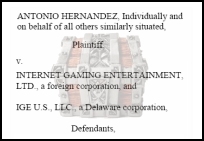 2008 starts with two developments in the Florida-based federal class action lawsuit against virtual property dealer IGE. First, the court has granted (.pdf) plaintiff Hernandez’s motion (.pdf) to drop Hong Kong-based defendant Internet Gaming Entertainment Ltd. because plaintiff was not able to serve the complaint on that defendant in the allotted time (U.S.-based IGE U.S. LLC remains in the case). Second, in a virtual law first, the Florida Attorney General’s Office of Economic Crimes has opened an apparently related investigation regarding IGE’s business activity in Florida, and has subpoenaed extensive records regarding IGE’s sales of “virtual goods.”
For the full background of this case, see VB’s complete coverage. In brief, plaintiff is suing IGE on behalf of essentially all World of Warcraft players on the grounds that IGE, by farming gold, spamming chat, camping spawns, and generally diminishing the World of Warcraft experience, allegedly prevented players from receiving the full benefits Blizzard intended them to receive as third party beneficiaries of Blizzard’s Terms of Use and EULA.
Hong Kong Defendant IGE Ltd. Dropped
Plaintiff Hernandez dropped his claims against Hong Kong-based defendant Internet Gaming Entertainment Ltd. because he was not able to serve process on IGE Ltd. within the 90 day extension period (.pdf) granted by the court last August 31. This is not terribly surprising; service via the Hague Convention frequently takes much longer than 90 days.
Florida Attorney General’s Office of Economic Crimes Opens Investigation
In regard to the investigation opened by the Florida Attorney General’s Office, the Newsome Law Firm (which is running the Hernandez case) reports that the Attorney General’s Office of Economic Crimes has issued an investigative subpoena (.pdf) to IGE U.S. for documents, “pursuant to the Florida Deceptive and Unfair Trade Practices Act in the course of an official investigation.”
The subpoena is the first formal document created as part of a U.S. governmental investigation that takes the existence of “virtual goods” as an accepted fact, even listing them in parallel with “goods” generally. Although it obviously has no formal value as “precedent,” it represents another instance of virtual property being recognized by a governmental body to which attorneys can refer in order to provide context.
The subpoena is extensive, seeking detailed information about IGE’s gold farming activity, business dealings in Florida, relationship with Affinity Media, and much more. Following are some key excerpts identifying categories of documents sought by the Office of Economic Crimes.


Related Posts on Virtually Blind
- New Lawyers Now Defending Virtual Property Company IGE in Hernandez Class Action Suit: "Virtual property company Internet Gaming Entertainment (IGE) has..." (0 comments)
- Hernandez v. IGE Update: Brock Pierce Declaration and Hernandez Motion to Compel Filed: "There are two new developments in Hernandez v. IGE. First, IGE has..." (1 comments)
- Hernandez v. IGE Settlement Watch – Parties Claim to Settle, Florida Court Declines to Seal Settlement Absent “Extraordinary Circumstances”: "World of Warcraft player Antonio Hernandez filed a motion claiming he..." (2 comments)
 Welcome to 2008! I’m not sure if it’s my inner litigator telling me to avoid going on the record with things that can make me look foolish, my inner philosopher telling me that the calendar change from December to January is a pretty arbitrary construct, or my inner skeptic telling me that predictions are just parlor tricks, but for whatever reason, I’ve been reluctant to do the traditional blogger’s New Year’s predictions, so I put it off until now. That all said, I’m pretty immersed in this stuff at the moment, as I’m doing a comprehensive editing pass on Virtual Law (slated for publication in April) so predictions are dancing through my head like last week’s visions of sugar plums. Besides, I’ve got a mountain of paper here, and I want to put off working on New Year’s Day for a few more minutes.
 Pacific Epoch