Subscribe to
Posts
Comments

The government may run a research project on public data in games. Yawn.

I was really hoping not to cover this, but the coverage I keep seeing is so over-the-top (e.g. TERRORISTS IN WORLD OF WARCRAFT!) that, having actually read the report in question, I’d be remiss not to at least briefly comment.

Here’s the real story of the Reynard Project (“Reynard” is a trickster fox from medieval European folklore and literature) from the report from the Office of the Director of National Intelligence to Congress (.pdf) that sparked the firestorm (report found via Wired’s Threat Level blog, emphasis is mine):

Reynard is a seedling effort to study the emerging phenomenon of social (particularly terrorist) dynamics in virtual worlds and large-scale online games and their implications for the Intelligence Community.

The cultural and behavioral norms of virtual worlds and gaming are generally unstudied. Therefore, Reynard will seek to identify the emerging social, behavioral and cultural norms in virtual worlds and gaming environments. The project would then apply the lessons learned to determine the feasibility of automatically detecting suspicious behavior and actions in the virtual world.

[...]

Reynard will conduct unclassified research in a public virtual world environment. The research will use publicly available data and will begin with observational studies to establish baseline normative behaviors.

So basically, they’re going to be standing on a virtual street corner noting how anonymous users interact and compiling data on that to try to establish a set of baselines from which they could, later, maybe spot deviations.
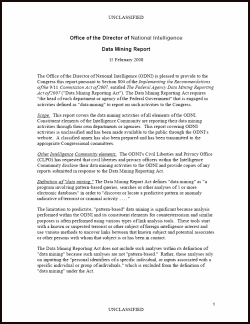
ODNI Data Mining ReportCommentary

This is simply not what everyone is making it out to be. The government is not investigating terrorists in World of Warcraft. They are not getting chat logs from providers. They are not secretly monitoring conversations. They’re just using cheap public data to see if they can spot patterns.

For another take on this, Juan Cole over at Salon debunks the idea of looking for terrorists in games pretty completely, but that article misses the much simpler point that that’s not even what they’re doing here. Not yet, anyway.

I think this is potentially pretty smart on the part of the analysts, and at least as written, it doesn’t raise privacy flags for me. They just appear to be hoping to mine the massive pile of conveniently anonymous publicly available data games produce regarding “social, behavioral, and cultural norms.” They hope this will, in the aggregate, eventually reveal patterns that they can apply later.

So, for example, they could learn that guild recruitment in a game typically follows a pattern of contact with a recruit that goes (a) leader, (b) third in command, (c) second in command, (d) leader. Not always, but often enough to be notable. They could then run that data over later contact patterns to try to spot apparent attempts at recruitment. They’re not going to be kicking in doors based on this kind of analysis, but it’s another data point, and collecting data points is what (typically boring) intelligence work is really all about.

There is sometimes good reason to suspect that a program like this will go beyond it’s intended scope, but this doesn’t have that feel to me. They’ve got an internal group advocating privacy issues, and the idea is to do all of this (at least at this stage) with publicly available data. If that’s all it is, I don’t really care. Sure, there’s a chance it’d go beyond the plan laid out here at some point, but that’s true of every program, and seems less true for this one than many. Privacy advocates have to pick their battles.

At bottom, it’s definitely a long shot, but they could get data they simply cannot get in the real world, at minimal cost and zero risk. It’s odd to think of analysts studying colonies of gamers like scientists study beehives, but if it stays at the macro and/or anonymous level and uses only public data, I sort of have to shrug. They’re not looking for terrorists in games, they’re just looking for social patterns that they can extrapolate from. That’s boring, and makes a lousy headline, but it’s really not all that bad — and not all that dumb.

Email This Post Email This Post
Print This Post (Printer Friendly Formatting) Print This Post (Printer Friendly Formatting)


Related Posts on Virtually Blind

AVW ScreenshotThe Association of Virtual Worlds, a new social network / virtual world project, has announced plans to create a virtual world with a focus on business and professional use.

The companion social networking site (sign-up available here) has only been active for about a week, but already has about 200 members, and is growing quickly.

AVW’s Executive Director is Dave Elchoness, an employment attorney who started VRWorkplace. The organization’s founder, Edita Kaye, has written a book on virtual worlds and runs iVinnie.com, a virtual world news site.

From the press release, currently available at the AVW home page:

‘The brand new Association of Virtual Worlds has as its mission to provide a leadership environment for companies and individuals passionate about the future of virtual worlds and as such it makes perfect sense to be the first such association to offer its members an exciting virtual world of their own,’ says founder Edita Kaye.

Dave Elchoness, Executive Director, explains ‘providing a virtual world environment is the next step—beyond Web 2.0 with its signature social networks—into Web 3-D. Why create a virtual world for members? To provide a real-time environment for meetings, conferences, collaboration, and social interaction and engagement with less cost, disruption, and environmental impact than physical travel. It doesn’t matter if you want to meet someone from around the world or the office next door, the Association of Virtual Worlds will help make it happen in a setting that feels ‘in-person’.’

AVW Logo

The Association has a lot of work to do, but appears to be rightly focused on making its virtual world genuinely accessible. It will be interesting to see where this goes; I’ve long felt that hyperspecialization is the future of the grid. Overused as the meme may be, virtual worlds really are better seen as the 3D web than an outgrowth of the gaming community, and in that light, this business-oriented “site” makes sense.

In the meantime, the discussions at the AVW social networking site are better than average, and it looks like a community that attorneys who are focusing on virtual worlds may want to join.

Email This Post Email This Post
Print This Post (Printer Friendly Formatting) Print This Post (Printer Friendly Formatting)


Related Posts on Virtually Blind

Technium LogoThe Technium recently posted a fascinating article about adding value in a copyright-adverse environment. The post is one of the most interesting things I’ve read recently. It should resonate with content creators who work in virtual worlds, and with attorneys advising clients about these spaces too. I will undoubtedly overgeneralize this very deep post by trying to sum it up, but in a nutshell, it argues that there are lots of ways to add value even in an environment where copying is rampant and copyright law isn’t respected (like free-form virtual worlds at the moment, particularly Second Life).

From the post:

[S]tart with a simple user question: why would we ever pay for anything that we could get for free? When anyone buys a version of something they could get for free, what are they purchasing?

From my study of the network economy I see roughly eight categories of intangible value that we buy when we pay for something that could be free.

In a real sense, these are eight things that are better than free. Eight uncopyable values. I call them “generatives.”

The author discusses these eight “generatives” in some depth. The article is focused on the internet generally, but I think it is particularly relevant to virtual worlds. I can already see how some of these are popping up in virtual worlds, even in my own shopping experiences. Could I find a cheap knock-off of a suit or prefab office I like in Second Life? Sure, but for three or four of the reasons outlined here, I seek out a “real” one. The article goes some distance toward explaining why, and it is well worth reading.

I’m not at all convinced that copyright enforcement is a dead end in virtual worlds (in fact, I suspect we will see much more of it over the next five years) but I think that it has to go hand in hand with other tools — like those discussed here — in content creators’ toolboxes as well.

Email This Post Email This Post
Print This Post (Printer Friendly Formatting) Print This Post (Printer Friendly Formatting)


Related Posts on Virtually Blind

Virtual Law Conference LogoThe schedule and speakers for the first-ever Virtual Law Conference are now posted, and registration is open.

The conference will be keynoted by Steve Mortinger (IBM Systems and Technology Group VP and Associate General Counsel), who will be discussing “The Top Ten Things a Brand Should Know about Virtual Worlds.” Other speakers and panelists include practicing attorneys, law professors, marketing strategists, and executives. I’m moderating a couple of panels, and also presenting “Virtual Law for Non-Lawyers,” a fast-paced overview of hot issues in virtual law for non-attorneys and lawyers new to this stuff.

The conference will be held at the Javits Center in New York, April 3-4. It will feature eight one-hour presentations on a wide range of topics including intellectual property enforcement, license agreement best practices, litigation strategies, virtual property, virtual currency, and more. Early registration ($595) is less than half the cost at the door, and is open until February 29, 2008. Registration also covers entrance to the “Virtual Worlds 2008” conference (which runs concurrently) and all associated events.

Virtually Blind is a media partner for the conference (hence, the advertisement you’ve seen running in the right column the last month or so) and I am one of the conference advisors and co-chairs, along with attorney Sean Kane. I look forward to seeing many VB readers in New York in April.

Email This Post Email This Post
Print This Post (Printer Friendly Formatting) Print This Post (Printer Friendly Formatting)


Related Posts on Virtually Blind


Page 33 of 87« First...«3132333435»...Last »