Subscribe to
Posts
Comments

Virtually Blind has obtained Brock Pierce’s Answer and Counterclaims (.pdf) responding to the Amended Complaint filed by Alan Debonneville (see earlier coverage) regarding various underhanded moves at well-known virtual property dealer, Internet Gaming Entertainment (IGE).

Debonneville v. Pierce CaptionAs is traditional with formal Answers in U.S. legal proceedngs, the first part of this is pretty dry, full of nothing but boilerplate admissions and denials.

One counterclaim, however, is awfully interesting. Pierce alleges that Debonneville, while overseeing IGE’s trading arm, overpaid certain people for virtual goods bought on behalf of IGE — including one of the lawyers who now represents Debonneville on this case — in order to secure favor and personal benefits, in breach of Debonneville’s fiduciary duty to IGE.

It isn’t every day that you see somebody whose name appears on the top of the pleadings get called out in the allegations; my guess is the move hasn’t done much to warm relations between the two camps.

As always, I must remind readers that this is an advocacy document and only tells one side of the story. From the Counterclaims:

19. In connection with performing his duties for IGE, DeBonneville became acquainted with various sellers of virtual currency and other items from whom IGE purchased such currency and items for resale.

20. One of those sellers to IGE was, at various times, Jose Portela, an attorney in Texas.

21. IGE paid the sellers from whom it purchased virtual currency and other items. The amount paid was often determined by DeBonneville, who was to set the payments at a rate more favorable than the market value, so that IGE would earn a profit upon resale.

22. Upon information and belief, DeBonneville developed a personal relationship with Portela and began causing IGE to pay Portela an excessive amount for any virtual currency or other items Portela sold to IGE.

23. Upon information and belief, DeBonneville began doing so in order to gain Portela’s favor and/or to obtain personal benefits from him.

24. DeBonneville, as an employee, officer, director and/or manager of IGE, owed IGE and Pierce a fiduciary duty including, without limitation, a duty of care, loyalty and candor.

25. Upon information and belief, DeBonneville breached his fiduciary duties by overpaying Portela in exchange for personal benefit.

Pierce also alleged defamation based on statements in the original Complaint (which his lawyers eventually had sealed), but has since dropped the claim.

Email This Post Email This Post
Print This Post (Printer Friendly Formatting) Print This Post (Printer Friendly Formatting)


Related Posts on Virtually Blind

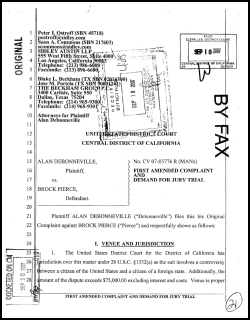
Debonneville v. Pierce CaptionVirtually Blind has obtained the Amended Complaint (.pdf) filed in the Central District of California on behalf of Alan Debonneville against Internet Gaming Entertainment (IGE) founder Brock Pierce. Debonneville is identified as a co-founder of US IGE.

The Amended Complaint (which I must caution readers is an advocacy document, and thus only reflects one side of the story) chiefly alleges that through a number of false statements, Pierce deprived Debonneville of millions of dollars Debonneville was owed under his agreements with IGE. Debonneville names an even dozen claims ranging from breach of fiduciary duty to fraud. Along the way he accuses Pierce of failing to pay taxes owed to the Spanish government, using corporate funds for personal expenses, falsely telling Debonneville that one of the other executives in IGE was blackmailing Pierce, and partnering with a third party, Jonathan Yantis, to exploit bugs in game software to make unauthorized duplicates of in-game items and currency to offer for sale via IGE.

IGE’s business model is based on real money trading (“RMT”) — buying and selling virtual currency and items in MMO games for real money. The vast majority of these sales are prohibited by the Terms of Service of the games in question. In spite of that, the virtual goods industry is significant and potentially highly lucrative. According to the Amended Complaint, IGE was at one point valued by Goldman-Sachs at $220m — nearly a quarter of a billion dollars.

Aside from the more colorful claims, the Amended Complaint represents a fairly typical fight between founders of a successful company over profits. An earlier version of the complaint (which was publicly available for several months before Pierce’s lawyers had it sealed) raised a number of much more scandalous allegations. That version of the complaint was the subject of an earlier article at VB. I’ll leave analysis of the business allegations in the Amended Complaint (which are extensive) for sites more focused on that end of things. From a virtual law perspective, there are two things worth noting.

Debonneville ComplaintFirst, this is yet another lawsuit that simply assumes the existence and value of “virtual goods” (as, of course, it must, since IGE is in the business of selling them). As such, if this goes to summary judgment, a resulting order could well end up referencing the apparent value of virtual goods even though the Terms of Service (TOS) and End User License Agreements (EULAs) for the games involved generally deny that they have any value.

The nature of virtual goods is unlikely to come up directly here because it is unlikely anyone will raise a defense based on the TOS (doing so would call attention to the fact that IGE’s business depends entirely on customers and suppliers violating contracts with game providers). That means that the value of virtual weapons, gold, furniture, houses, and everything else may simply be taken as as given by the judge. That could provide some interesting citation possibilities for future briefing in cases involving virtual goods. I’m not holding my breath though; cases like this frequently settle before summary judgment, particularly when valuation is straightforward and (as appears true here) both parties want to avoid publicity.

The other interesting aspect of the Amended Complaint from the standpoint of the “big picture” questions in virtual law is that it focuses attention on the methods by which IGE procures gold and virtual items for sale. Specifically, the Amended Complaint alleges that a virtual property dealer named Jonathan Yantis (who now, according to the complaint, controls the RMT arm of IGE) “stated that through the hiring of certain individuals who he had a long time business relationship with, Yantis would sell currency that had been exploited or duped.” The Amended Complaint continues:

Exploiting or duping is a process whereby an outsider hacks the game program into creating currency for the individual or duplicating an item and then selling it over and over which also results the creation of currency. These actions allow for the exploiter/duper to create an endless supply of currency without any real cost to that currency. This is something that Yantis had done in the past and had made large profits from. The exploiter/duper would typically receive a commission for any currency sold of about 40% of the sales price. Due to the currency being exploited, Yantis was and would be able to sell currency at a price significantly below market, since the cost of the currency sold was non existent. This also allowed for an infinite supply to be created in what could take as little time as a few minutes.

Yantis indicated that this was also how he could tum the trading arm of IGE around and make it profitable, almost instantly. Pierce was aware of Yantis’ intent to use these exploits. In fact, Pierce counted on them as part of the rationale behind why Yantis should be brought back to work for IGE.

This raises some interesting questions. As much as most players and providers say they hate gold farming and sales that are derived from in-game mechanics, the phenomenon pales in comparison to the damage that can be instantly done to a virtual economy via item and gold duplication bugs. But from a contract law perspective (and thus a business perspective) the question is, somewhat disturbingly, essentially the same — violating the Terms of Service by selling farmed gold isn’t much different than violating them by duplicating gold and then selling it. Should civil law differentiate? What about criminal law? What about goods in games where the provider or a sanctioned third party offers and profit from sales (such as the Station Exchange/Live Gamer service for some EverQuest II servers) on which IGE operates? This case isn’t likely to provide much direct discussion on this point, but it does highlight some troubling questions.

Virtually Blind is acquiring the rest of the documents in this case, including Pierce’s Answer and Counterclaims, and will post them over the next week or so. There is a mandatory settlement conference scheduled for March 10. If the case fails to settle, a jury trial is scheduled for May 20 in Los Angeles, presided over by the Honorable Manuel Real.

Email This Post Email This Post
Print This Post (Printer Friendly Formatting) Print This Post (Printer Friendly Formatting)


Related Posts on Virtually Blind

Virtually Blind periodically runs “quicklinks” — items that are not long enough for a full story, but are worth a click. Here’s today’s, slightly less quick than usual.

  • First, it is old news, but I’d not seen this courts-and-virtual-property story until a reader sent it in. Apparently, way back in December, 2003 a Chinese court “ordered an online video game company to return hard-won virtual property, including a make-believe stockpile of bio-chemical weapons, to a player whose game account was looted by a hacker.” China’s courts aren’t known for giving stare decisis the same weight western judicial systems do, so it may be more of a blip than anything else, but it’s interesting nonetheless. [Update: The reader who sent this in, Matt Nolin, has a short post about this up now. Thanks for the heads-up on this, Matt.]
  • BNT's Ancapistan BuildingToday, of course, the debate rages on. Most recently, someone known only as avatar ‘Arthur Burma’ threatened yet another Second Life “bank” (BNT Financial, managed by ‘IntLibber Brautigan’) with a class action lawsuit (via an in-world notecard written in sufficiently advanced legalese and with just enough reserve to make me think a lawyer might have had something to do with it). The text of the notecard is available at Your2ndPlace.com. The core claim is that “BNT misrepresented the condition of the institution and perpetrated a ponzi scheme by taking deposits while restricting access to accounts and ignoring requests for records and adjustments.” I have no idea if the claim has merit (I’ve not looked into this bank in particular) but there’s no procedural reason people could not bring a class action suit based on a loss of real money to BNT.

  • Finally, there’s a new academic paper up at SSRN on criminal law as applied to actions in games and virtual worlds. It’s by Orin Kerr at George Washington University Law School, and it adds significantly to the growing body of literature on virtual law. I’d have cited it in Virtual Law: Navigating The Legal Landscape of Virtual Worlds (which is slated for publication April, 2008) but just finished final edits. It encourages a fairly hands-off approach which will resonate with game designers. I disagree with some of Kerr’s conclusions (particularly to the extent he lumps pure games and social virtual worlds with real economies together) but it is a thought-provoking piece and well worth reading.

[Edited March 2, 2008 to add link to Matt Nolin's blog.]

Email This Post Email This Post
Print This Post (Printer Friendly Formatting) Print This Post (Printer Friendly Formatting)


Related Posts on Virtually Blind

Virtual Law Conference LogoQuick note to remind readers that February 29 is the last day for early registration for the Virtual Law Conference in New York City, April 3-4. Registration also covers entrance to the “Virtual Worlds 2008” conference (which runs concurrently) and all associated events. The price goes up $300 after the 29th, and another $400 at the door.

Virtually Blind is a media partner for the conference, and I am one of the conference advisors and co-chairs, along with attorney Sean Kane. The conference will be keynoted by Steve Mortinger (IBM Systems and Technology Group VP and Associate General Counsel), who will be discussing “The Top Ten Things a Brand Should Know about Virtual Worlds.” I’m looking forward to seeing many VB readers in New York in April.

Email This Post Email This Post
Print This Post (Printer Friendly Formatting) Print This Post (Printer Friendly Formatting)


Related Posts on Virtually Blind


Page 32 of 87« First...«3031323334»...Last »