Subscribe to
Posts
Comments

Virtually Blind periodically runs “quicklinks” — items that are not long enough for a full story, but are worth a click. Here’s today’s batch.

  • The Second Life Newspaper reports on a DMCA success story. Apparently Linden Lab acted on a properly documented DMCA claim regarding an alleged instance of purely in-world infringement. From the article: “Do take heart honest content creators and designers, file your DMCA in the correct manner and do not give up, every little thing counts.”
  • On the other hand, that’s apparently a drop in the bucket. See recent articles on content theft in Second Life from ‘Tateru Nino‘ (via Massively) and ‘Morris Vig‘ (via Second Arts). Ziggy Quirk YouTube VideoWhat has focused everyone’s attention? One straightforward video regarding Second Life content theft that ‘Ziggy Quirk’ put on YouTube, featuring the real-life person behind the avatar talking frankly about the impact of content theft. ‘Quirk’ is right when she says, “Eventually the creators in Second Life are going to stop creating. [...] What’s the point in making quality products if someone can just get their hands on it, put it out in their own store, distribute it as a freebie, and pass it around the grid? Nobody’s going to bother.” (Via New World Notes.)

  • GH LogoCongrats to Mark Methenitis, who landed a cool gig doing his Law of the Game thing every week over at Joystiq as a regular feature. His first column focused on Guitar Hero as a potential cash-gaming platform. The idea is that since it is 100% skill based, it wouldn’t fall under gambling laws. The idea works — if you’ve played GH, you know that each of the songs is identical every time you rock out, so there’s not even a tiny bit of luck involved. Interesting concept.
  • Tech Law Forum’s Erik Schmidt ran a post suggesting that some griefing may lead to tort actions. It’s not the most groundbreaking article, but it makes a good point, and hey, there’s a snapshot of ‘Hiro Pendragon’ (who isn’t a griefer) with a pair of katanas and a cup of coffee.
  • And on that point, ‘Pendragon’ recently analyzed Julian Dibbell’s Wired article on griefers. He concludes Dibbell is a griefer-symp. My take? A small percentage of what griefers do, particularly in social virtual worlds like Second Life, is criminal and/or actionable under civil law, but most game-based griefers do not cross this line. The guys Dibbell interviewed mostly don’t do the really bad stuff, which does slant the piece a bit, but not more than you’d expect given that it’s running in Wired.

  • Facebook GiftsLightspeed points out three use cases for virtual goods. One is that people like paying money for things as gifts (e.g. Facebook’s seemingly constant barrage of $1 icons representing pumpkins, candy, firetrucks, underwear, legal pads, and whatever) simply because paying money for something signifies the importance of the gift, and thus the giftee. There are other interesting thoughts here too.
  • If your pixelated junk gets jacked, though, good luck convincing the police to investigate. Particularly if you live in Blaine, Minnesota and you’re reporting the theft of l33t l00t from Final Fantasy XI (via twincities.com). From the article: “Investigators said points earned in games are devoid of monetary value.” I’m sure it’s easy to blow this kind of thing off if you’re a busy cop, but this is nonsense. Ski lift tickets are non-transferable and have no monetary value by agreement too, but if somebody was stealing them from skiers in the lift line, you can bet the Blaine police would check into it.

Email This Post Email This Post
Print This Post (Printer Friendly Formatting) Print This Post (Printer Friendly Formatting)


Related Posts on Virtually Blind

JOLT LogoThere is a notable new paper on virtual law from Farnaz Alemi running in the current issue of UCLA’s Journal of Law and Technology. The article, An Avatar’s Day in Court: A Proposal for Obtaining Relief and Resolving Disputes in Virtual World Games, reviews a number of in-world incidents which will be familiar to VB readers, ranging from the Anshe Chung animated genitalia attack to the EVE Online EIB scam, and then outlines a proposal for an in-world dispute resolution system. Alemi, a 2007 graduate of Northwestern, is with the law firm of Latham & Watkins.

From the article:

Game developers, then, should also incorporate into their EULAs and game design relief system that will temper avatar deviance and increase overall player satisfaction. After all, almost every other facet of the real world is playing out in virtual worlds. As such, this paper introduces a virtual court system for virtual game worlds. The system is not a policing mechanism, but more of a discretionary forum for avatars to actively seek justice and equity when they have been wronged.

Though I don’t agree with everything here (particularly, I don’t view scams in EVE online as “crimes,” nor do I view the defacing of John Edwards’ in-world fan-site campaign office as “terrorism”) the main point is a good one, and the article is thought provoking. It is well worth your click.

Alemi gave me a heads-up on this last week, but recent gold farming lawsuit developments (I wonder if the system she proposes would work against them…) took precedence this weekend. Dan Hunter’s post on the article at Terra Nova this morning reminded me, so a hat tip is in order.

Email This Post Email This Post
Print This Post (Printer Friendly Formatting) Print This Post (Printer Friendly Formatting)


Related Posts on Virtually Blind

Blizzard v. In Game Dollar CaptionBlizzard’s lawsuit against virtual item and power-leveling company In Game Dollar (doing business as Peons4Hire) has settled, resulting in a permanent injunction (.pdf) that essentially shuts down In Game Dollar’s entire World of Warcraft operation. Though no monetary damages are specified, the injunction represents a complete victory for Blizzard. The news is likely to be well received by the World of Warcraft player community, which voiced widespread support for Blizzard’s move when the lawsuit was filed.

Blizzard brought the lawsuit against In Game Dollar in the Federal District Court for the Central District of California last May. The Complaint (.pdf) alleged that In Game Dollar violated World of Warcraft’s Terms of Use and End User License Agreement by spamming chat in World of Warcraft with advertising. This, Blizzard alleged, diminished players’ game experience and cost Blizzard subscribers, bandwidth, employee time, and ultimately, revenue.

Blizzard claimed six causes of action, including violation of the Computer Fraud and Abuse Act, interference with contract, and trespass to chattels.

Peons4Hire was not the largest virtual property dealer in World of Warcraft, but it was well known for aggressive in-game marketing via chat spam. The lawsuit could be seen as a shot across the bow of larger sellers.

The key provision of the injunction specifically prohibits In Game Dollar from “engaging in the sale of World of Warcraft® virtual assets or power leveling services.” In Game Dollar is also permanently enjoined from:

Bag of LootMaking any use of the World of Warcraft® in-game communication or chat system to advertise any website, business, or commercial endeavor, including any business associated with In Game Dollar, LLC or www.peons4hire.com.

Sending messages to the World of Warcraft® servers, the World of Warcraft® in-game communication or chat system or any other computer used by Blizzard in connection with the World of Warcraft® game, if such messages mention or advertise the website www.peons4hire.com, In Game Dollar LLC or any other commercial endeavor.

Making any unauthorized use, or obtaining any unauthorized access to Blizzard’s computer systems or network.

The injunction also prohibits In Game Dollar from investing in a new operation doing any of the enjoined acts, and authorizes the court to award damages in the event that the company violates any of the terms. Essentially, the injunction puts In game Dollar out of the World of Warcraft virtual item and power-leveling business. The Peons4Hire website is down.

Blizzard LogoBlizzard has taken what is arguably the most aggressive legal stance in the industry against gold farmers, chat spammers, third-party bot providers, and others who violate World of Warcraft’s Terms of Use and End User License Agreement. The company’s actions have been widely praised both by players and by commentators who follow legal issues in games and virtual worlds. Blizzard was represented in this lawsuit by Sonnenschein Nath & Rosenthal LLP.

The injunction is part of a settlement, so it does not carry the precedential weight that a decision on the merits would carry. However, it joins last year’s default and consent judgments resulting from intellectual property claims in Second Life as yet another example of a court entering a judgment regarding virtual property (here, “virtual assets”) without comment or apparent concern regarding the subject matter of the agreement. For those watching this space, it represents another small step toward recognition of virtual property.

The Court retains jurisdiction for the purposes of enforcing the injunction, but the case is otherwise concluded.

Email This Post Email This Post
Print This Post (Printer Friendly Formatting) Print This Post (Printer Friendly Formatting)


Related Posts on Virtually Blind

Editor’s Note: At the request of Brock Pierce’s attorneys, this article has been edited to remove three passages summarizing portions of the now-sealed complaint. Although the complaint was filed June 11 and publicly available for more than three months before Pierce’s attorneys had it sealed, it was eventually sealed, and they have provided an order signed by the judge that establishes this.

Notably, a judicial order sealing a document is directed to the Clerk of the Court, and it merely prohibits further distribution — it has no direct impact at all on non-lawyer journalists, and it certainly does not stand as an order censoring news coverage if a reporter does manage to learn the contents of the document. That said, as an attorney, I am subject to professional standards that go beyond the responsibilities of non-attorney reporters, and I must respect those responsibilities.

I am working hard to bring readers coverage of the amended complaint and answer in the near future. That, frankly, will be a more interesting story anyway. The original article (with the three aforementioned edits and additional discussion of the sealing order) follows.

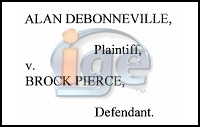
Debonneville v. Pierce Caption

The Complaint in a lawsuit filed last summer in California against Brock Pierce, founder of virtual property company Internet Gaming Entertainment (IGE), recently surfaced on a new website managed by the consumer justice law firm behind the tangentially related Hernandez v. IGE class action lawsuit. The plaintiff in the California lawsuit against Pierce is Alan Debonneville, a Swiss citizen living in Hong Kong. Debonneville is identified in the Complaint as one of the co-founders of US IGE.

[DESCRIPTION OF THE COMPLAINT REMOVED AT THE REQUEST OF ATTORNEYS FOR BROCK PIERCE.]

The Complaint was first posted at a new site, MMO Citizen, which is managed by the Newsome Law Firm of Orlando Florida.

From the post at MMO Citizen:

Regardless of the merits of Debonneville’s claims, the complaint is an insider’s perspective of one of the largest, or at least best-known, RMT companies. For those who study virtual worlds and their economics – both virtual and real world – Debonneville’s complaint provides a detailed first-hand account from an insider’s perspective that reads like a novel.

[DESCRIPTION OF THE COMPLAINT REMOVED AT THE REQUEST OF ATTORNEYS FOR BROCK PIERCE.]

[The complaint was filed June 11, 2007, and was sealed over three months later, on September 17, 2007. Until that time it had been publicly available. It was sealed with one sentence near the end of a "proposed order" granting a motion to strike certain portions of the complaint. The order was apparently written by attorneys for Brock Pierce and presented to the judge, who scratched out the word "proposed" and signed the order without other modification. Although "proposed orders" are common in many situations, one does not typically request that documents be sealed by appending the request to another order in the Central District of California. This is at least partly because appending a request to seal to another order does not create a docket entry of an "Order to Seal" that the Clerk, journalists, and other interested parties can easily reference.]

Richard Newsome told VB that his understanding is that the document is public. “We got it from somebody who got it from the Clerk’s office,” said Newsome.

[DESCRIPTION OF THE COMPLAINT REMOVED AT THE REQUEST OF ATTORNEYS FOR BROCK PIERCE.]

It is clear from the docket that Pierce has answered the Complaint and filed counterclaims of his own, but these documents have not yet been made public. The lawsuit has progressed into the discovery phase, and the parties recently asked the court for an extension of time to complete discovery or settle. The case is scheduled to go to trial May 20, 2008.

Broken Toys (one of my favorite sites) got the story about the same time VB did, and has additional coverage of Debonneville v. Pierce, including some great excerpts from the complaint focusing on the alleged business shenanigans [but has removed its story at the request of Brock Pierce's attorneys, replacing it with a picture of a cute kitten.]

Email This Post Email This Post
Print This Post (Printer Friendly Formatting) Print This Post (Printer Friendly Formatting)


Related Posts on Virtually Blind


Page 35 of 87« First...«3334353637»...Last »