Subscribe to
Posts
Comments

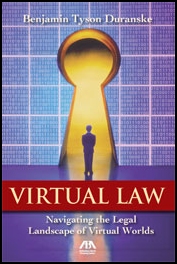
Virtual LawA couple of updates on my book, Virtual Law: Navigating the Legal Landscape of Virtual Worlds.

First, there are two early reviews of Virtual Law that I want to share with readers.

Taran Rampersad recently posted what I think is the very first review of Virtual Law and gave it a full 10/10 on KnowProSE. Taran is a virtual worlds consultant and a writer. From the review:

The book is timely, circumspect, well written and grounded where it is supposed to be while provocative in areas that it needs to be. The author’s experience in virtual world use and commentary shines as he teases out the importance of law to virtual worlds, and vice versa. Benjamin Duranske makes virtual law in concept and practice very tangible and understandable. This book is not only a book introducing Virtual Law — it is a book of reference for lawyers, virtual world users and virtual world owners alike.

Dr. Edward Castronova of Indiana University, a well-known commentator on virtual worlds and games, occasional expert witness on the economics of 3D networked environments, and creator of Arden: The World of William Shakespeare, also offered some very nice comments.

Ben Duranske hits the mark again and again with this clear, straightforward overview of legal issues in virtual worlds. All of the main arguments are here, in a single source, allowing the reader to balance the claims of contract law against those of property law in regulating the toughness of the magic circle. Woven together, these arguments constitute a desperately-needed consensus, one that recognizes the inevitable influence of real-world law on the future of this critical medium, but also its limits.

Dr. Castronova’s comments are particularly appreciated in light of the fact that I owe him and well-known game designer Raph Koster a correction. As you would expect, Virtual Law refers to the works of dozens of scholars, writers, and game designers. In fact, it is the kind of book that is only possible to write from the high vantage point offered by a perch on the shoulders of giants like Castronova, Koster, and others. Unfortunately, one key passage in the book misattributes Edward Castronova’s theory of “interration” to Raph Koster. The theory is correctly attributed in other places in the book, but somehow, this reference slipped by in spite of dozens of editing passes. Dr. Castronova is well known in legal and gaming circles for the theory of interration, and I actually have a dog-eared copy of the paper where he proposes the theory sitting on my desk right now. My most sincere apologies to both gentlemen for the incorrect attribution; it will be corrected in the next print run.

Because the passage is an important one, and because I am a big fan of Castronova’s theory, I am running a corrected version below. Consider it a sneak preview of one of the big-picture arguments set forth in Virtual Law.

Read the rest of the post »

Email This Post Email This Post
Print This Post (Printer Friendly Formatting) Print This Post (Printer Friendly Formatting)


Related Posts on Virtually Blind

Debonneville v. Pierce CaptionAccording to minutes (.pdf) obtained from the court, a recent settlement conference in Debonneville v. Pierce — a lawsuit between two founders of virtual property company Internet Gaming Entertainment (IGE) — has resulted in a tentative settlement agreement.

At the settlement conference where the tentative agreement was reached, the Honorable Margaret A. Nagle ordered the parties to finalize the agreement and file a stipulation of dismissal by April 14. Although nothing has yet been filed, both parties have signed a Memorandum of Settlement, indicating that they are in agreement on all key terms. The details of the agreement are confidential and neither Pierce’s nor Debonneville’s attorneys responded to requests for comment.

The case, which was filed in the United States District Court for the Central District of California, caught the attention of the gaming press both because IGE is widely reviled by players and designers, and because Pierce and Debonneville accused each other of lengthy dirty-laundry lists of business, ethical, and personal failings.

For example, Debonneville’s Amended Complaint (.pdf) claims that Pierce failed to pay Spanish taxes, used corporate funds for personal expenses, falsely told Debonneville another IGE executive was blackmailing Pierce, and partnered with a third party, Jonathan Yantis, to exploit bugs in game software to make unauthorized duplicates of in-game items and currency to offer for sale via IGE. For his part, Pierce’s Counterclaims (.pdf) accuse Debonneville of overpaying certain clients for virtual goods with IGE’s money — including one of the lawyers who now represents Debonneville on this case — in order to secure favor and personal benefits. For the whole tawdry story, see VB’s earlier coverage.

Commentary

It is not particularly surprising that the case appears to be ending in settlement. As VB noted last month, business disputes like this frequently settle at this stage — particularly when valuation is straightforward and both parties want to avoid negative publicity.

What does this mean? Probably that Pierce (or more realistically, IGE’s insurance company) is going to be writing a big check to Debonneville. It will be considerably less than the $40 million that the complaint implies he ought to get, but it won’t be nothing either. With motion practice leading up to trial, the cost of defense in a case like this could easily push into the millions, and that’s a lot of motivation to settle.

From a virtual law perspective, I’d been hoping against hope that these two charming gentlemen would continue knocking their heads together for another couple of months, and that the judge would accidentally say something meaningful about virtual property while trying to sort out their nonsense, but that doesn’t appear likely now.

You never know though; if the parties are unable to finalize their agreement (unlikely, but always a possibility when there’s as much bad blood as there appears to be here) a jury trial is still scheduled for May 20 in Los Angeles.

Email This Post Email This Post
Print This Post (Printer Friendly Formatting) Print This Post (Printer Friendly Formatting)


Related Posts on Virtually Blind

I just got back from New York where I was attending Virtual Worlds 2008 and the concurrent Virtual Law Conference 2008. I was a bit too involved with the law conference to get to really experience the rest of it, but people tell me it was great. The two big stories from the conference are that Barbie Girls is going to start offering some content by subscription, and that IBM is putting some of its Second Life servers behind its own firewall.

Barbie Girls ScreenshotBarbie Girls “VIP” Subscriptions

The Barbie Girls VIP subscription model doesn’t have much to do with law, but it’s interesting from the standpoint of the future of monetization of virtual worlds for kids.

I hadn’t seen a lot of the toy/game companies at the last one of these, but they were out in force this time. Made for a fun show floor and created some really odd moments, such as being introduced to “Rosie O’Neill, our chief Barbie Girl” at a speaker reception the first night. Rosie’s not a booth babe who stands around handing out branded pens, she’s a Mattel executive who has a lot to say about the future of Barbie Girls, and she gave half of the keynote — but I’m a guy who grew up in a family that viewed Barbie as a plot to brainwash little girls into believing that lipstick was more important than logarithms, so Rosie’s title made me nearly drop my beer. Looking at the product though, I love the idea of a virtual world for girls, if for no other reason that that it gets girls involved in computing at an early age.

Startups Moving Out of Stealth

Along the monetization lines, this conference marked the first public appearance for a lot of startups that are moving out of stealth mode. The vast majority of these are kids worlds, but I talked to a significant number of people who are working on business-oriented virtual worlds too.

What didn’t I see though? Anything that looks like a direct competitor to Second Life. Post in the comments if I missed it and you know of something, but I didn’t hear anybody even talking about offering the combination of a) unfettered content creation, b) user-retained ownership of intellectual property rights, and c) a real market for in-world currency. I half-expected to see a big pavilion for somebody I’d never heard of (or Google Earth 5.0) in the middle of this exhibit floor giving out the best tchotkes and making the Linden Lab people a little nervous, but I didn’t. My guess is we will pretty soon — maybe at the next one of these in LA this fall.

IBM’s Move to “Own Virtual Land!”

Regarding IBM, my understanding is essentially that they are going to start running some of the IBM islands behind an IBM firewall, largely private from Linden Lab. It is not clear to me whether the actual servers will share space in the Linden Lab farm, or will be geographically separated and totally under IBM control. I got different answers from different IBM representatives there, so I think that it is probably still up in the air. Either way, this gives far them greater control over data retention and security, and it is a big move that, in my mind, signals the future of this space.

Notably, this model is the only way that I’d recommend “practicing law in a virtual world” (which I don’t, right now, though they are fantastic places to network, meet potential clients, have educational and training sessions, and even exchange non-confidential data). If a law firm can get its own firewalled server and Linden Lab doesn’t have access to the chat logs, though, I will be be infinitely more comfortable interacting with clients in the space. Same is true for business — private servers mean that conversations about trade secrets are possible. Whether via Second Life, somebody else, or, I think most likely, via the emergence of a set of standards (the web/HTML model) individual hosting of portions of a larger virtual space seems inevitable to me, and from the standpoint of business and law, absolutely necessary.

Steve Mortinger, IBM’s VP & Associate General Counsel of the Systems and Technology Group, keynoted the Virtual Law Conference, and he noted that one of the bigger problems for IBM (and other high tech companies using virtual worlds for meetings) is one I’d not thought of: export restrictions. You can’t practically discuss or show a model of a chip that handles encryption (as just one of dozens of examples) in a virtual world right now because you do not know where the traffic goes, or who might have access to logs from countries under export restrictions. Steve also pointed out that IBM’s new model is at least a step toward alleviating a number of other concerns that came up over and over in the legal sessions: confidentiality, security, and parter identity.

Virtual Law Conference

I spent most of my time in New York dealing with the Virtual Law Conference track — moderating panels, speaking, and helping keep things moving. I was really pleased at the turnout for a lot of the panels and presentations, and want to thank the organizers for putting this together. The number one request, by far, was that we offer CLE (continuing legal education) credit next time, and I agree that we need to make that a priority. We haven’t even started talking about the next one of these yet, but if I am advising again, I will definitely push for it. Thanks to everyone who participated in the conference: organizers, speakers, and most of all, the attendees.

Along those lines, I am speaking in Dallas in a couple of days at the Spring Meeting of the ABA’s Business Law Section as part of a panel on legal issues in virtual worlds and games. Shoot me a note if you plan to be there.

Email This Post Email This Post
Print This Post (Printer Friendly Formatting) Print This Post (Printer Friendly Formatting)


Related Posts on Virtually Blind

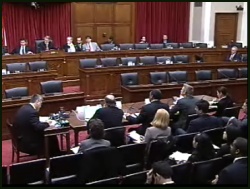
Congressional Hearing ScreenshotThe first-ever Congressional hearing on virtual worlds took place today in Washington. Linden Lab CEO Philip Rosedale testified, along with representatives of IBM, TechSoup, and the New Media Consortium.

The hearing was conducted by the Subcommittee on Telecommunications and the Internet (a subcommittee of the House Committee on Energy and Commerce). It was cast as an educational hearing, essentially a first look at these spaces for subcommittee members. With a few notable exceptions, the subcommittee members displayed a better understanding of virtual worlds than one might have expected, and both their comments and the testimony offer a look at the future of virtual law and the interaction between real world governments–or at least the U.S. government–and virtual worlds.

Opening Comments

Edward Markey (D-Massachusetts), who chairs the subcommittee, seems to have a surprisingly solid understanding of virtual worlds. He described virtual worlds as a “glimpse into future [and] a window into current reality for millions of people.” He noted that “at their best, virtual worlds are vehicles for understanding across boarders and in communities.” The concerns he listed were also on point: consumer protection, intellectual property protection, online banking, gambling, and child protection.

The ranking member of the committee, Cliff Stearns (R-Florida) also seemed to come in with a good understanding of virtual worlds and a clear focus on the future. He recognized something that a fair number of commentators seem to miss: this isn’t really about Second Life in the long run. Stearns noted that “better graphics will lead to avatars that look, walk, and act just like real people [...] in the very near future.” He did point out that virtual worlds can “enable egregious social behavior and social ills,” but emphasized, at two different points in his remarks, that virtual worlds “can best flourish without overregulation.”

Another bright spot was Gene Green (R-Texas) who noted that virtual worlds provide a “realistic way to get experience running an entrepreneurial venture.” Green also used the opportunity to push for more support for broadband deployment and competition.

The opening remarks went downhill from there. Several representative did not seem to understand the difference between games and social virtual worlds (one joked, “you’ll only get two experience points for attending this hearing”). Another said it made him uncomfortable that the word “avatar” means “god” in Hindu philosophy (“we’re not gods…”). Jane Harman (D-California) compared using a laptop while sitting on the beach to “working in a virtual world,” and focused her remarks on a somewhat suspect press report of terrorists “using virtual worlds to transfer money and find new recruits.”

Testimony to the Subcommittee

Philip Rosedale (soon-to-be-ex-CEO of Linden Lab, the company that runs Second Life) offered a few opening remarks about the benefits of Second Life and ran a video highlighting some of the interesting, socially acceptable things people do there. There was not a “Strokerz Toyz” poseball in sight.
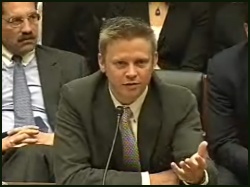
Rosedale Testifying Before CongressThe subcommittee members seemed willing to let Rosedale discuss the benefits of these spaces to an extent, and displayed some real enthusiasm for them. Several members even pointed out that they had avatars.

However, the subcommittee focused a fair portion of Rosedale’s testimony on one potential problem: child sexual predation in virtual worlds. In one exchange, Chairman Markey pressed Rosedale on the lack of safeguards in the Second Life software to flag suspicious behavior, asking, “How do you keep the adults out of the teen area and teens out of the adult area?” Rosedale said that following a standard “best practice,” the teen community was encouraged to report suspicious behavior. Markey interrupted him: “But once there, they could camouflage themselves.” Markey pushed for specifics, asking if Linden Lab gets social security numbers or a driver’s license (it doesn’t) and if not, then how does it know a users’ age, beyond self-reporting? Markey did not seem convinced that the self-reporting and community-based measures Rosedale said were in place were sufficient, noting, “A lot of people would not tell the truth. If they’re going into there with some overt intent, they’d not be truthful.”

One piece of information that will be of interest to both attorneys looking at Second Life as a repository for potential discovery and Second Life users concerned about privacy is that, according to Rosedale, Linden Lab currently keeps communication logs for “several weeks.”

Representative Bart Stupak (R-Michigan) returned to the line of questioning later, asking Rosedale if they had “set up any kind of sting operation” in Second Life. “We have not,” Rosedale said, “but I suspect law enforcement agencies may have done so. We have not, as a company, felt a need to do that.”

Stupak then asked about limits on excessive use. Rosedale pointed out that “excessive” needs to be sensitive to what the application is, since virtual worlds offer so many choices. “If you’re killing monsters,” he said, “then too much can make you unable to perform well in human society.” On the other hand, Rosedale noted, running a small business in Second Life can be “a lemonade stand experience, and may be superior to other kinds of learning.”

Representative Jane Harman (D-California) repeated her concerns about terrorism based on the largely discredited idea that terrorists are using virtual worlds for training, recruitment, and fund transfers. [Update: New World Notes points out that a team of anti-terrorism investigators does try to track jihadists in Second Life, so it's not an absurd point or as discredited as I thought, though I do think that Representative Harman overstates the danger.] She started by reading part of a Sunday Times “virtual jihad” article from last August into the record and asked Rosedale to respond. Rosedale pointed out that Second Life manually reviews all transactions of more than US $10, and noted that “as a company we have never seen any evidence that there is any such activity going on in Second Life.” He also pointed out that “because we have a stronger recorded identity there, it is likely that virtual world activities are somewhat more policeable and the law is more enforceable there than it is on websites.”

In addition to Rosedale’s testimony, TechSoup’s Susan Tenby, Senior Manager of Community Development, discussed non-profit opportunities in virtual worlds, IBM’s Dr. Colin Parris discussed the future of these spaces as the natural evolution of the 2D internet into three dimensions, and Dr. Larry Johnson, Chief Executive Officer of the New Media Consortium, focused on the educational opportunities these spaces offer.

Dr. Parris’s testimony regarding the opportunity for businesses to make money in these spaces was particularly interesting. Ranking member Cliff Stearns asked how virtual worlds could be used by businesses beyond “just marketing.” Parris focused on inexpensive distance communications, product simulations and design, and particularly on the benefits of using virtual worlds for training. He noted that it “is more cost effective” in the long run to conduct interactive training in virtual worlds. He said that while it is “early in cycle, there are a number of ways that these do help businesses make money.”

April 1: Updated to add reference to commentary from New World Notes on potential terrorism in virtual worlds.
Email This Post Email This Post
Print This Post (Printer Friendly Formatting) Print This Post (Printer Friendly Formatting)


Related Posts on Virtually Blind


Page 29 of 87« First...«2728293031»...Last »