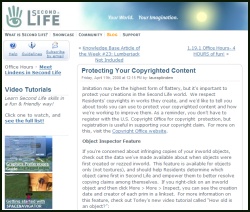
 Linden Lab, creator of Second Life, recently posted guidelines for protecting your copyrighted content in Second Life. The policy largely focuses on the DMCA (Digital Millennium Copyright Act). From the guidelines:
The DMCA provides a specific process for removing content that’s much faster and less expensive than a copyright lawsuit. Otherwise, courts resolve copyright claims – usually only after reviewing evidence about a work’s creation, ownership, permissions given, and defenses like fair use.
This is accurate; the DMCA is an important tool in a creator’s IP enforcement toolbox. Filing a DMCA notice is much cheaper than filing a lawsuit, and to the extent that an online service provider (which Linden Lab clearly believes it is, according to the guidelines) complies with the Act, it can be a very effective way for a creator to inexpensively police infringement. That said, it only works — and only shields the provider from liability for infringement — when both users and the provider comply with all of the requirements of the DMCA.
Commentary
There is a reasonable argument that in spite of its recent moves to make the DMCA process easier for users, Linden Lab is not complying with its obligations because it is not removing all infringing copies when DMCA notices are filed. This, arguably, opens Linden Lab to a lawsuit for vicarious or contributory copyright infringement by depriving it of the protections of the DMCA.
Let’s get this out of the way right off the bat: copyright infringement in Second Life is widespread. Some of it involves residents using the intellectual property of mainstream companies without a license (e.g. selling unlicensed Harry Potter and Star Wars products, playing streaming music in clubs without payment to the artists via ASCAP or BMI, selling unlicensed e-books, etc.) but a lot, probably the majority, involves residents selling unauthorized copies of other residents’ copyrighted creations. Because Second Life allows unfettered building and offers a fairly robust programming (“scripting”) language, users can, and have, created a number of tools that allow people to copy other people’s creations. These tools have non-infringing uses, so Linden Lab allows them, but takes action when they are used to infringe copyrights.
 Linden Lab has always had a DMCA policy, but reports are mixed regarding the company’s diligence in following up. Some users have reported success, but others have said their notices are ignored.
My guess is that many of the apparently ignored requests were actually improperly formatted, though I’m sure there have been cases where properly formatted requests were overlooked. A few attorneys I’ve spoken with who represent virtual world users have said that requests filed on behalf of their clients have generally been acted on, although it often took some time. This may be because a request from a lawyer gets a bit more attention, or it may simply be that these requests are likely to include all of the required information.
As Linden Lab points out, the DMCA process is somewhat complex:
It’s important to note that the DMCA process is a legal process. The U.S. Congress created it for online service providers like Linden Lab because it’s hard for them to know whether a work is infringing without a court’s determination. So it’s critical to follow the steps in the DMCA policy. [...]
To help with information required under the DMCA, we’re also developing a new form for submitting DMCA claims. The goal of the form is to help Residents provide all the necessary DMCA information upfront and reduce the number of claims that require supplementation (which slows down the process because we need to ask the Resident who filed the claim for more information).
Streamlining the process should help users file complete notices. This makes it easier for Linden Lab to do what it is supposed to do under the DMCA.
There have also been complaints about the time it takes for Linden Lab to act on notices. If it takes eight weeks to remove infringing content (as creator ‘Cal Edman’ alleges), there is an argument that Linden Lab is not “acting expeditiously” to remove infringing copies, in violation of its DMCA obligations. The creation of the reporting tools mentioned in the guidelines, and the deployment of additional human resources to address DMCA notices (which Linden Lab also says it is now doing), should help address these concerns.
However, there is one significant criticism of the way Linden Lab handles DMCA requests that remains a serious problem: users report that Linden Lab only removes copies that are “in-world,” and does not remove copies from inventories or remove copied textures from its database. If this is true — and it appears to be given the widespread gnashing of teeth over the issue and Linden Lab’s silence on the question — there is a reasonable argument that Linden Lab is depriving itself of the “safe harbor” protection of the DMCA by not complying with its DMCA obligations.
Read the rest of the post »
 The folks at Clever Zebra just announced a legal panel for the vBusiness Expo, which will be held in Second Life next week.

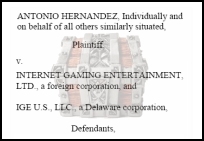 Virtual property company Internet Gaming Entertainment (IGE) has
