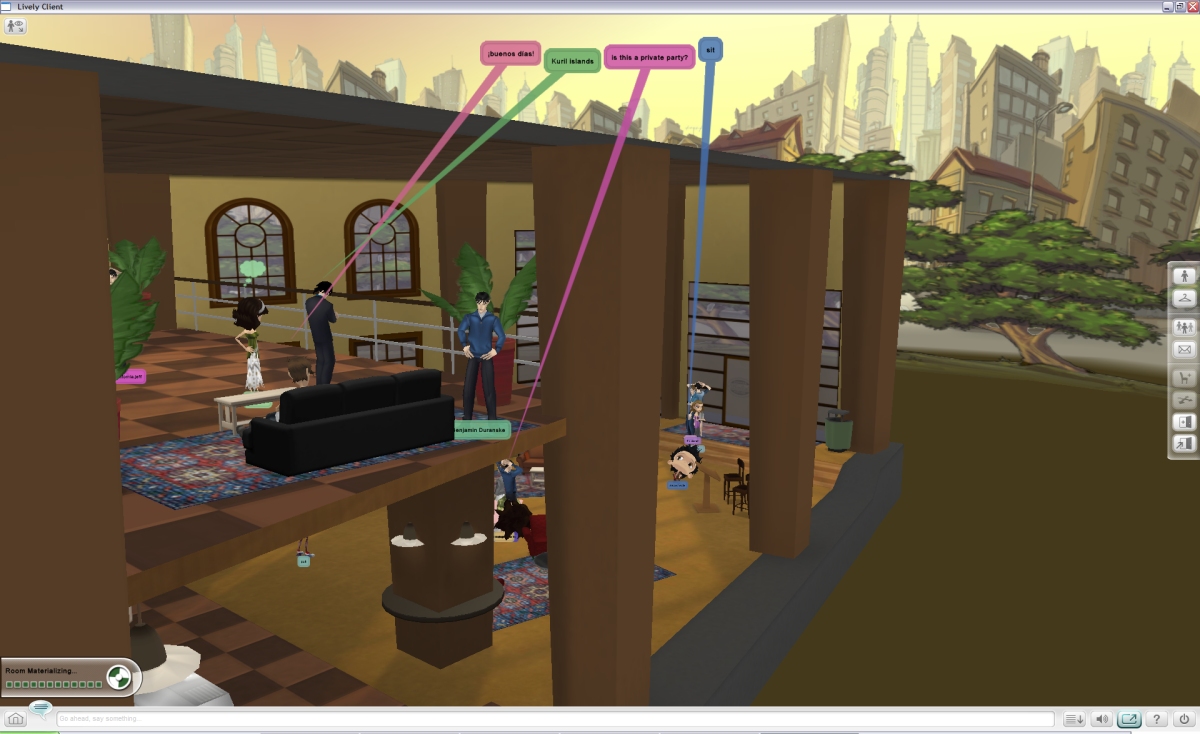
I downloaded and installed Lively yesterday (the “it’s in the browser” hype aside, Lively requires a download since it operates as a plugin). Somewhat oddly, there was no EULA or TOS document to agree to during the installation process. Indeed, there were no options or buttons to click on at all. Double-click “Install Lively” and a few minutes later, a you see “Thanks for installing ‘Lively by Google.” No click-through? No draconian terms of service? Cool. But on the other hand, no options regarding what is installed and where it went? I’ve never much liked hidden installs, particularly from  companies that are in the business of cataloging everything.
Turns out the TOS is on the web site, and a comment from PJ on VB’s first post on Lively breaks down the install: “you have to download their installer program – which then sets itself up as service on your system for instance. You don’t get to chose where on your system to install it either. And while a browser plugin might be necessary to run this in the browser, why would it be necessary to install a [Browser Helper Object] for google update?” That’s a very good question.
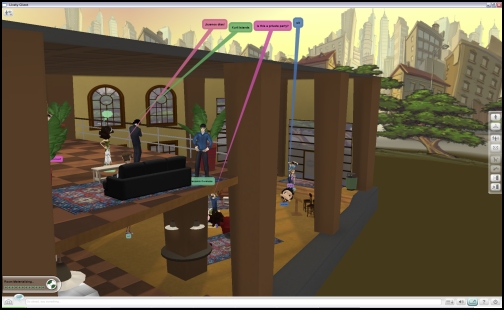 Though there’s no click-through agreement, the Lively Terms of Service themselves are linked at the bottom of the Lively homepage. My initial impression is that they’re either kind of half-baked in comparison to the TOS and EULAs we’re used to seeing from MMO games and virtual worlds, or a genuine attempt to slim down the legalese. Either way, there are aspects which seem likely to be revised in the future.
For example, the Legal Notices section currently includes this provision:
Your Intellectual Property Rights
You agree to release Google, its affiliates, and their agents, contractors, officers, and employees (collectively, “Google Parties“), from all claims, demands, and damages (actual and consequential) arising out of or in any way connected with a dispute. You agree that you will not involve any Google Party in any litigation or other dispute arising out of or related to any transaction, agreement, or arrangement with any other user, any developer, or any other third party in connection with the Lively Service. If you attempt to do so, (a) you shall pay all costs and attorneys’ fees of any Google Party and shall provide indemnification as set forth below, and (b) the jurisdiction for any such litigation or dispute shall be limited as set forth in the Terms.
Three comments on this. First, it is one of the most direct “do not sue us for stuff users do” provisions I have ever seen. It says if you have “a dispute … with any other [Lively] user … developer, or … third party” you agree not to sue Google too. It isn’t quite that simple. Though the provision provides some protection for Google, there are a number of theories under which you could bring suit in spite of it — if you did and lost, though, Google would probably try to collect its attorney fees under the provision above. Somewhat oddly, Google does not reference their DMCA policy here, which is actually what would govern their liability for at least the copyright side of IP. That policy is linked in the “Community Standards” section of the TOS.
 Second, although this doesn’t say so directly, it appears that users do get to keep whatever IP rights they’d otherwise have in anything they create in Lively. This isn’t specific to Lively, it comes from Google’s general TOS (repeated on the Lively site). Aside from giving Google an irrevocable license to make copies and modify your content in order to host it, “you retain copyright and any other rights you already hold in Content which you submit, post or display on or through, the Services.” This is arguably better than Second Life’s TOS, as it doesn’t carve out an exception for patent rights. At least for now, though, user created content aside from largely pre-defined venues is not really an option anyway. From the Lively FAQ:
Add and Remove Objects: Can I Create Content?
Most of the avatars, clothing, and objects were created by vendors working for Google. We’re also working with a small number of trusted testers, vendors and creative agencies as part of a test for creating custom items.
We hope to enable user-generated content and even more customization soon, but until then we’ve given you tons of choices from the catalog to help personalize your Lively experience.
Finally, regarding this section, it appears that the legal documents are just as much in beta as the service. This provision, for instance, was clearly just copied and pasted out of a gmail-specific document.
Indemnification
Google does not claim any ownership in any of the content, including any text, data, information, images, photographs, music, sound, video, or other material, that you upload, transmit or store in your Gmail account.
The Community Standards section is also interesting. That is where Google sets out what you can’t do in their virtual world. It’s a rather long list, and appears to squarely place Lively in the PG-13 camp. The whole list of no-nos is below:
Read the rest of the post »
 Quick reminder that the SL Bar Association’s first CLE (Continuing Legal Education) seminar will be held in in Second Life at the SLBA offices Tuesday, July 15, 2008 at 12:00 Noon Pacific. The seminar will feature SLBA President ‘Solomon Cortes’ (David Naylor) presenting “Virtual World Legal Issues.” This marks the very first time that CLE credit has been offered for an exclusively in-world event. There is no charge for the seminar, and you’ll earn 1 hour of California MCLE or England and Wales CPD credit for attending. Registration is currently still open, but space is limited.

 Unless you’re living in a

 But could the lack of action by Activision Blizzard allow competition to stealth in and claim the gold? Heavyweights EA and Will Wright (of Sim City and The Sims fame) are keen on
 At what point do we know that technology has gone too far? Looking back at historical waypoints, the answer is easy…when it’s too late. The latest in the line of totally amazing and potentially scary products has emerged.
 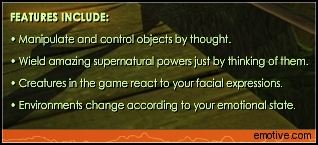 Currently, the neurohandset is showcased in a new