Virtual Law Quicklinks: Emptying the Linkbucket
July 19th, 2008 by Benjamin Duranske
Virtually Blind periodically runs “quicklinks” — items that are not long enough for a full story, but are worth a click. I haven’t done this in a while, and I’ve got a ton of both on-topic and off-topic goodies, so here’s an extra large batch.
Following up on last week’s first-ever virtual world CLE (Contuining Legal Education) session, the SL Bar Association is offering an additional four sessions for CLE credit in Second Life over the next couple of months. The next one is Tuesday, July 22, and features ‘Juris Amat’ (Tamiko Franklin) covering intellectual property enforcement in virtual worlds. Sign up here. Space is limited.
 The SL Bar Association is also holding elections this month. I started the organization in late 2006, and the group elected its first full administration last summer. I can hardly believe it’s time for elections again, but it is. If you use Second Life and are not already involved, now is a great time to become a member.
This one is a mystery for readers: a May 12, 2008 WSJ op-ed piece (not mine, which makes mine the second in two months to reference virtual worlds) stated that “In the virtual world Second Life… the State Department now has an embassy.” Does anybody have a lead on this? I can’t find it, and this is the only source I’ve seen for this.
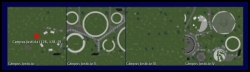 And here’s a mystery solved: a while ago, VB speculated about a mysterious 4-sim legal build in Second Life from Madrid’s Campus de la Justicia. The build is open now, and you can check it out here (SLURL). Pretty cool, though I have no idea what they’re going to do with it. (Thanks to ‘Lem Skall‘ for the heads-up.)
VB made the Ultimate Guide to Internet Law, which is basically a big list of guides and resources ranging from niche sites like this one to giants like Findlaw. I found some new sites there, and it’s worth a click.
A registry for avatars called Avatars United raises the idea of protection of this new genus of intellectual property via community consensus. It’s a seemingly novel idea, but it has worked pretty well for clowns. No, really, for real clowns. (Thanks to reader ‘Doubledown Tandino‘ for the links.)
Got a Playstation 3? You can get a preview of Sony’s forthcoming virtual world product / game lobby via the Sony Home beta. If you get in, tell me what you find. I’m an Xbox guy.
Speaking of games (yes, this is off topic) anybody out there playing Civilization IV? I’m itching to set up a long term server-based game using the pitboss feature against people I know (I’ve got a spare 24-hour server). It seems like that would encourage conspiracy and diplomacy via email, which has got to add to the Civ experience. Let me know if you’re up for it. One turn per 24 hours, so not much of a daily commitment, though it’s a long term thing.
Along the “building historical stuff” lines, a browser-based 3D virtual world creation platform called 3DXplorer hit my radar screen last week. One of their initial pitches is recreating famous places as 3D virtual worlds, and yes, I’m geeky enough to think that kicks ass.
 I also recently came across Playmotion, which is a company working on hardware to let you control stuff on the screen with your body. That is, in my opinion, one of the hardware keys to virtual worlds getting really, really big. Why? Because a mouse is a 2D thing — the desk is flat — and virtual worlds are 3D things. So you’ve got to be able to wave your hand (or move a glove, or whatever) and have the thing on the screen do the same thing for these to really work as immersive.
There’s a nice review of my book, Virtual Law, from Dan Miller (Senior Economist, Joint Economic Committee, U.S. Congress, Minority Staff) here: Duranske on Virtual Law. Dan makes great points, some of which I am definitely going to consider when I put the next edition together in a couple of years.
Not Possible IRL tossed out an interesting idea last month: including a Creative Commons option in the Second Life creation toolkit so people can easily mark their stuff with various CC licenses. I’m for it, but think it needs to be paired with equally as obvious options for traditional protection or else it will create a culture where people feel bad marking stuff for traditional licensing. Both models have to get fair credit for the plan NPIRL advocates to work.
I don’t remember how I found this, but it’s a more intelligent than usual discussion of the economics of Linden Lab’s virtual currency from Marginal Revolution.
The Google-translation-hashed HiPiHi Terms of Service are interesting. The doc is close to unreadable, of course, but this jumps out: “You create all forms of content (including text, music, pictures, videos, articles, etc.), under the terms of service, HiPiHi acknowledge and agree that you create for your enjoyment of the contents of copyright and other intellectual property. In the context of the applicable law, you can retain any or all of the copyright and other intellectual property.” That apparently includes patent rights, meaning that the leading Chinese virtual world grants users greater retention of their intellectual property than the leading U.S. virtual world.
 Read this piece, check out the picture to the left, realize that “81186 PED” equals $8,118.60 at a guaranteed exchange rate and that the only way to get a shot at this kind of prize is by buying stuff from Mindark, and then tell me with a straight face that Entropia Universe is not simply the world’s prettiest slot machine.
This one’s for the guys who use Second Life: I just ran across Men’s Second Style, a site dedicated to fashion for male avatars. Given how hard it is to find a decent suit and pair of shoes in the virtual world, I suspect a number of readers will want to check it out.
Finally, arguing against people (like me) who are convinced that 3D networked environments are now on the immediate horizon, this post at Feet of Clay says: “I’ve yet to have anyone explain to me how the web’s utility is improved by turning it into 3D.” I’ve seen that point made on this blog in comments too, and I’m not trying to be dismissive here, but I’d just turn it around — if given the opportunity, would you make the real world 2D? If not, then there’s your answer. Aside from text and some graphic art, most stuff isn’t 2D to start with, so once the technology catches up, it’s easier to deal with it in its native form.
If you’ve got a short item that might fit in Quicklinks, shoot me a note. I get the coolest stuff from users, and this feature is often were these submissions go.


Related Posts on Virtually Blind
- Intel Partners with Chinese Virtual World HiPiHi: "Chinese news source Pacific Epoch reports that global semiconductor..." (1 comments)
- Coming Soon to a 3D Printer Near You: Mixed Reality Intellectual Property Infringement: "This one may make your head hurt a little bit, but it highlights a..." (5 comments)
- What the Hell am I Doing “There?”: "I'll try to be open minded here, but it's going to be hard. I set up..." (8 comments)
 I’ve got a
  Last month, attorneys from across the state of California gathered in the posh Beverly Hills Hotel, vacation home of the stars, for the Intellectual Property Section of the California State Bar’s conference on Entertainment & Media. (With special guest appearance by
  trip down there to meet Stan Lee (whose presentation had nothing to do with the law, but was incredibly interesting nonetheless).
 Blizzard has won its
