Accountability and Transparency in Virtual Banking: VB’s Interview with SL Bank’s ‘Teufel Hauptmann’
January 16th, 2008 by Benjamin Duranske
You probably haven’t heard of Joshua Zarwel (Second Life’s ‘Teufel Hauptmann’), but he was the very first person I thought of when Linden Lab banned banking last week. ‘Hauptmann’ doesn’t get a lot of press. He’s never been accused of insider trading or blackmail in the Second Life Herald, he doesn’t spend much money on his avatar, he  doesn’t issue cringe-inducing press releases, and he doesn’t have his name in diamonds above his virtual door. In short, he’s the kind of guy you want managing your money.
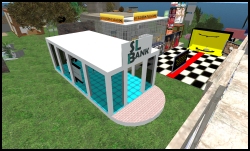
You probably haven’t heard of SL Bank, Zarwel’s investment fund, either — its consistent, honest, 27-30% return rate pales in comparison to claims of 100% to 300% from other banks. The fund’s web site is plain, and its entire in-world presence consists of one tiny, unremarkable virtual building. The building has standard-issue white walls and a bright blue tile floor. It just fits on the 512m plot of land that is included with Zarwel’s Second Life account. It does not have a waterfront view or a private heliport; it is wedged between one store selling costumes for avatars and another selling construction supplies.
SL Bank’s whole in-world presence, from floor to ceiling, uses 102 prims (prims are the basic shapes used to build, the more you use the more you pay). That is about half as many prims as are used in the gilded fountain on the landscaped lawn in front of the sprawling headquarters of one of SL Bank’s better-known competitors. SL Bank has no plush conference rooms, no scrolling tickers for buddies’ virtual stock prices, no flat-panel TVs hanging from the ceiling, no glittering dollar signs on the walls, and no menacing avatar bodyguards.
What SL Bank does have is integrity — lots of it. When Linden Lab ended banking in Second Life last week, Zarwel did something I’ve not heard of any other banker doing: he quietly announced that every single Linden Dollar in his customers’ accounts was available for immediate withdrawal. No compulsory shifts to shady bonds, no “liquidity problems,” no complex deals with friends. ‘Hauptmann’ didn’t have to make excuses because SL Bank was not insolvent.
He made money by taking advantage of an inefficient market for Linden Dollars and, until landbots became common, an inefficient market for virtual land. He bought for less than he sold. Consistently. It is not glamorous, and it takes a lot of effort, but it works. It is easier to make large returns (like Zarwel’s 27-30%) in an emerging economy than a mature one using this method because emerging economies have less efficient markets. This is something ‘Hauptmann’ can point to with specificity. It is real and quantifiable, unlike other Second Life bankers’ vague incantations about the “speed of the economy” and the “stupendous growth rate” of the virtual world.
This story is an important coda to a point I have felt compelled to make far too often over the last year. Many banks in Second Life were ponzi schemes, many relied on phony accounting, and many are now insolvent — but not all of them. SL Bank, and, in all likelihood, a few others, quietly built legitimate, highly profitable operations that would have easily satisfied any auditor, and more importantly, at least from the standpoint of those who would like to see virtual worlds remain as free from further regulation as possible, would not have attracted unwanted attention in the first place.
It is easy for lawyers and journalists to focus on the negatives in the virtual world banking industry, but that is only part of the story. The other part is the story of SL Bank, and that story is best told by ‘Hauptmann’ himself.
“VB” is Virtually Blind, “TH” is ‘Teufel Hauptmann.’
VB: You go by ‘Teufel Hauptmann’ in-world, but you’ve been pretty open about who you are. Can you tell readers a bit about yourself?
TH: I’m 29 years old, 30 this February (oh my god!). I was born in Germany, grew up just outside of Washington, DC and now live in New York City where I work as a consultant and study at New York University where  I completed a BA in Economics and am now slowly working on a graduate degree with a focus on Development Economics & Globalization Studies.
I became interested in virtual worlds after my cousin introduced me to Ultima Online in early 1998. There had been other massive multiplayer online games before it (MUDs I believe they were called) but this was the first I had seen with a graphical interface. After a few hours, I was hooked. A few months into playing I noticed a surprisingly high level of inflation in the economy. I began to investigate and found that the hyperinflationary state was due to constant injection of “gold” into the virtual economy. (After each virtual kill, you would often be rewarded with “loot” in the form of gold, which could then be traded with other players or used to buy virtual goods such as weapons or reagents from Non-Player Characters.) This was the first time I asked myself an economic question pertaining to a virtual world. When I learned about Second Life and its open and often volatile economy, I joined the next day. That was back in 2005, when Second Life was MUCH smaller and no one but us true geeks had any idea of what Second Life was.
VB: Were you surprised by Linden Lab’s decision to ban banking?
TH: Simple answer, no. I had been expecting it for years. When I saw the blog post, my immediate reaction was “Oh, it finally happened.” I wasn’t happy about it, but not upset. The fact is that it was simply too easy for anyone to set themselves up as a “bank”, “fund” “stock exchange” or whatever, and take in deposits even if they had no idea of what they were doing and/or if they were someone there to simply steal deposited funds.
 VB: How rampant do you feel fraud was in the virtual world banking industry prior to the Linden Lab policy change?
TH: That is difficult for me to gauge. I have definitely heard of at least three “banks” which had shut down operation and simply left the world, never returning a large majority of deposits. I have also heard of at least five “CEOs” of virtual companies which raised capital via a virtual stock exchange and then left Second Life with the raised IPO funds never to be heard from again. The main problem I saw was with accountability. Many people in Second Life seem to feel that it is a normal thing to not disclose who you are in real life; bank owner or not. Because of this, people may have felt it was normal to invest in a virtual bank, fund, stock or stock exchange which did not disclose any real world information. Some “scammers” may have taken advantage of this train of thought and the human being’s weakness of greed and opened such projects with the intent to steal deposited funds with little to no fear of anyone calling them out on their lack of transparency. Simply open a fancy looking bank or stock market, tell anyone who asks that you don’t wish to disclose who you are as that is your right in a virtual world, offer an eye catching rate, sit back and wait for deposits, shut down shop and go on a six month vacation.
VB: I was really impressed with SL Bank when we communicated last summer, to the degree that I intended (though I never got around to it) to deposit some Linden Dollars with you, even though I felt there was a lot of fraud in the industry as a whole. Can you explain to readers what your business model was?
 TH: SL Bank is/was an arbitrage fund. In virtual worlds, due to smaller populations and higher risks (LL could turn off the L$ anytime or simply shut down SL all together), markets are less efficient than similar markets in the real world. SL Bank took advantage of this situation by arbitraging those inefficiencies. We would, for example, buy L$ on the LindeX and then sell them again at a profit on the same exchange. SL Bank would also buy and sell virtual land, but we moved away from land trading after “land bots” made the land market more efficient and less profitable. Because our deposits were used to arbitrage L$ exchange inefficiencies, they remained liquid, which is important in a virtual world where the economy is volatile and change is frequent.
We did not invest in any other financial projects in SL. This allowed us to maintain complete control over our holdings. As we now see, some banks, exchanges and funds in SL are having trouble liquidating because their funds are tied up in yet other banking and exchange projects which are having the same problem.
We kept our bank location to a minimum. Why buy entire sims to place one measly ATM? SL Bank’s in world location consists of one 512 plot on which the ATM sits. The plot is paid for by my SL account, which provides one free 512 plot with your subscription to the SL service. Thus, none of our funds were tied up in lavish banking locations.
And finally, we tried to be as transparent as possible. If you check our website and/or in world note card you will see that we provide our real world names, addresses, backgrounds, profitability, fund allocation, etc. We had nothing to hide, nor did we ever wish to be anonymous.
Our goal was to remain highly liquid, profitable, to retain complete control over all of our holdings at all times, to be transparent and to be as thrifty with in world purchases and land holdings as possible.


Related Posts on Virtually Blind
- Metanomics Panel on Second Life Banking Rules Change Today, 11 AM Pacific [Updated]: "Metanomics, the popular in-world speaker series, will feature a panel..." (10 comments)
- Ginko Financial Suspends then Limits Withdrawals; Head ‘Nicholas Portocarrero’ Calls it a “Bank Run,” Tells Depositors to “Calm Down”: "One of Second Life's high-interest, self-styled "banks," Ginko..." (10 comments)
- Commentary: Linden Lab Bans Unlicensed “Banks”: "Linden Lab has announced a new policy regarding banking, essentially..." (43 comments)
 VB is pleased to bring readers a new, notable paper in virtual law,
  Fumble #4: “People shouldn’t go to jail for negligence!” This usually shows up as an outraged response to an article where a lawyer says that a company or individual could be held “liable” for something fairly innocuous. Generally, all the lawyer is saying is that the person or company might be subject to civil liability — a lawsuit. There’s no prison for people who breach contracts or, in most cases, for executives who act negligently, just a loss of money and some bad press following a videotaped deposition, hundreds of interrogatories, and a lengthy trial… of course, some might argue that fate is actually worse. [Addendum: criminal negligence exists, though it is not usually what "liability" is referring to here. See comment #2.]
 Fumble #1: “If no one’s been convicted, it must be legal!” This is by far the most common fumble analysts make regarding questions in virtual law. It is fed by the (admittedly appealing) idea that virtual worlds are “just different.” It is nonsense. Consider this: nobody has figured out how to kill with a blue laser beam yet. If someone does so though, it would be completely reasonable to say that the act is illegal even before a jury finds a defendant guilty of that particular method of murder. Juries evaluate facts, the law is what it is. The fact that people just recently figured out how to defraud each other using prim-based ATMs, in-world messages, and avatars, doesn’t change the fact that the underlying fraud is, itself, illegal.
 The US branch of Internet Gaming Entertainment (IGE U.S. LLC) recently answered plaintiff Hernandez’s complaint. The answer is available
