Guest Commentary

A recent guild disbandment in World of Warcraft may mark the beginning of the decline of “Virtual Worlds” into “Virtual Countries,” as conflict of law issues make it nearly impossible to fairly enforce rights and duties.
As first reported by WoWInsider, a World of Warcraft guild called “Abhorrent Taboo” was recently disbanded for allegedly engaging in erotic role-playing during gameplay. Abhorrent Taboo’s members allegedly engaged in simulated intercourse in-world, sometimes while role-playing minors (a practice known as sexual ageplay). The guild also allegedly allowed minors to participate in sexual role-play activities, and did not check whether its members were minors or adults.
WoWInsider reported that the guild was shut down on September 17, however the guild immediately reformed with a new name, “Vile Anathema.”
‘Lilith,’ one of the guild’s leaders (her name possibly referring to a Mesopotamian demon who was, apocryphally, the first wife of Adam) stated in an interview to Daily Gaming News that “the guild is back in full swing and we’re even encouraging new members to join in the fun!” ‘Lilith’ also suggests that the guild was allowed to re-form because one of the members is a Blizzard employee, saying, “I promised I wouldn’t give out their name, 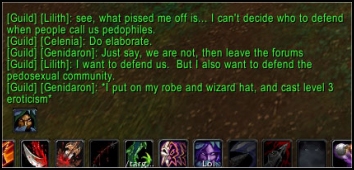 since they could lose their job. But let’s just say that not everyone at Blizzard is as uptight about what we do as the people who banned us.”
There are various legal questions arising from this incident. The first involves the precautions virtual forums may take regarding age verification: is “click and deposit” sufficient, or should game and virtual world companies use measures like Linden Lab’s Identity Verification (subject to significant criticism)? The second question regards the enforceability of End User License Agreements (EULAs) and their role as the new public law in Virtual Worlds; the enforceability of these unified contracts is still in question. These questions, and others, form the backdrop for my concern.
Different countries have different approaches to both exposure (and participation) of minors in sexual activity (whether virtual or physical) and to the presentation of sexually explicit content involving either minors or others portraying minors (virtual or physical). Facing negative press and potential legal problems in Germany, Linden Lab took steps to remove ageplay from Second Life a few months ago. Though a statute criminalizing virtual child pornography was deemed unconstitutional in the United States (Aschroft v. Free Speech Coalition), U.S. citizens (who would otherwise be allowed to engage in ageplay in Second Life) are barred from it due to the laws of foreign nations, including German and Israeli law. The implication is a constitutional tort: legal speech is barred by the private sector. This constitutes private laws made by the proprietor of the virtual world. I am concerned that these private laws may bar otherwise legal speech.
Virtual worlds span through countries, bringing together citizens from different jurisdictions. In the same manner that Yahoo! was barred from hosting auctions for Nazi memorabilia in France (and, consequentially from running auctions for Nazi memorabilia anywhere, since it cannot distinguish French users from others) and that Linden Lab was forced to ban online gambling in Second Life, which is legal in parts of the world but not in the U.S., and prevent residents from establishing online casinos. Virtual Worlds essentially wind up obeying statutes from all jurisdictions, limiting themselves to almost no conduct that is offensive to anyone, anywhere.
For example, earlier this year, Michael Carlton, CEO of online sportsbook Victor Chandler, was arrested in Israel. An Israeli court asserted jurisdiction over Carlton, a foreign citizen, and stated that as long as a portion of the illegal activity (here, gambling) occurred in Israel, there is no need for universal jurisdiction, and the website operator is subjected to the Israeli law (State v. Carlton, Hebrew decision). The court stated that it was in Victor Chandler’s responsibility to bar all communication from Israel since the activity they offer is illegal for Israeli citizens to participate in.
Using the same rationale, any employee of Blizzard or Linden Lab could be subjected to the Israeli penal code, as they are allowing illegal conduct (under Israeli law) to take place on their servers. Blizzard could face harsher liability as it distributes World of Warcraft actively in Israel, while Second Life is only available for download.
The only solution to these legal problems is to separate players according to countries, or even states (as some state laws in the US differ regarding pornography and violence). Any other solution may cause a conflict of laws, and subject the industry to liability twice: the first is the constitutional tort, where legal expression is barred though there is no local legal reason to bar it (e.g. ageplay in the U.S.) and the second is potential criminal prosecution by another state which may prosecute company leaders for user actions that are actually legal in the home country of the company.
Jonathan J. Klinger is a Cyberlaw Attorney from Israel, writing his LL.M Thesis on speech norms at The Interdisciplinary Center In Hertzelia. You can find more of his articles in his blog, 2jk.org (English, Hebrew).
Guest Commentary on VB solely reflects the opinion of the author, and not necessarily the opinion of VB’s editor, other VB writers, or VB’s sponsors.


 There was a good in-world presentation yesterday on protecting brands in Second Life. The panel was hosted by ‘Celebrity Millionsofus’ (Mark Allen) of

