Copyright accusations between Second Life designers occur on what seems like a weekly basis. 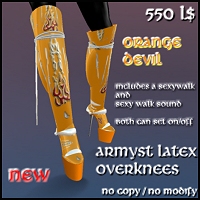 The legal analysis is always the same, so VB doesn’t typically cover them. This week’s spat (via the SLH) is notable, however, as it reveals that Linden Lab is choosing not to do Digital Millennium Copyright Act “takedowns” based on accusations of copyright infringement between in-world clothing designers.
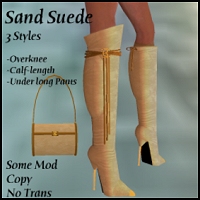
The designers involved in this dust-up are ‘Panjomy Ames’ and ‘Bax Coen’ (SLURLs). The design at issue is a pair of boots with three strands of decorative cord tied below the knee. ‘Ames’ did the “Orange Devil” design pictured right, and ‘Coen’ did the “Sand Suede” design pictured below. Both filed DMCA takedown notices, and, according to the Herald article, both have been told that Linden Lab will not be taking any action.
Legal Analysis of Copyrights in Real and Virtual Clothing
In most, if not all jurisdictions, you can’t copyright real-world clothing designs (via Expert Business Source). This is because articles of clothing (like teapots, hammers, and tires) are considered “useful articles.” There are several public policy justifications for this, but the primary one is that the public has an interest in using useful articles that supersedes designers’ interest in preventing copying. Designers hate this, because they think of what they are doing as artistic expression and just as worthy of protection as paintings and poems, but that is not the way the law sees it.
Notably, the reason you can’t copyright articles of clothing is not because (as people often say) everything has already been done in clothing and innovation is difficult. It is simply because clothing is classified as a useful article.
 But here’s where it gets tricky, and where there is no solid answer yet. Nobody knows whether articles of clothing that exist solely in the virtual world are “useful articles” or not. No court has said so, and there are good arguments both ways.
The Argument Against Allowing Designers to Copyright Virtual Clothing
The argument against allowing copyrights in virtual clothing is that a dress in the virtual world is just as much a “useful article” as a dress in the real world. Recall that the theory behind the prohibition against copyrights in articles of clothing as “useful articles” in the real world is that the public’s need to use items that are useful (rather than decorative) outweighs the policy justifications for protecting the design. What makes clothing a “useful article?” In the real world, it keeps us warm. And in virtual worlds? It keeps Club Penguin from looking like a cold, aquatic, Red Light Center. That’s not a bad argument.
The Argument For Allowing Designers to Copyright Virtual Clothing
On the other hand, the argument for copyright protection of clothing sounds pretty good too. People who want copyrights in virtual clothing will argue that the analogy that should be applied isn’t to real clothing, but to artistic renderings of real clothing. Certainly, paintings and drawings of articles of clothing are copyrightable, so why shouldn’t a CGI image of an article of clothing be copyrightable too? Not a bad argument either.
Commentary
I’d take either side of this one in litigation, but I suspect that in the long run, virtual articles of clothing will end up being considered useful articles for roughly the same public policy reasons that real articles of clothing are — we really don’t want people, or avatars, to be naked all the time. Until this is decided one way or the other, however, companies that run free-form virtual worlds (like Linden Lab) will have to decide how they want to approach this issue.
As reported in the SLH, Linden Lab has declined to do DMCA takedowns in this case. I would guess that doesn’t reflect a case-by-case decision about these particular boots, but a general policy regarding disputes over copyright claims in virtual clothing. The downside to refusing to do takedowns is fairly minimal: Linden Lab is choosing not to avail itself of the DMCA’s “safe harbor” provision for any claims that may arise from these disputes. But considering that (a) this area of law is unsettled, (b) there is a reasonable argument that avatar clothing is not copyrightable anyway, and (c) the monetary value of a lawsuit or arbitration claim would be insignificant to Linden Lab, it seems like a reasonable business risk that allows Linden Lab to maintain some distance from these disputes and avoid committing resources that are better used elsewhere.
 Linden Lab announced today that it reached a confidential settlement with Marc Bragg which allows Bragg to return to Second Life as avatar ‘Marc Woebegone.’ Bragg had brought suit against Linden Lab in the Eastern District of Pennsylvania after Linden Lab revoked his Second Life account claiming that Bragg purchased virtual land at far less than its typical value by accessing parts of the Second Life website that were not generally open to the public. From Linden Lab’s press release:

 Although this kind of agreement (technically, a “
