Subscribe to
Posts
Comments

Emotive EPOCAt what point do we know that technology has gone too far? Looking back at historical waypoints, the answer is easy…when it’s too late. The latest in the line of totally amazing and potentially scary products has emerged. Emotiv, a San Francisco-based (take that, Silicon Valley) tech company has created the new EPOC neuroheadset, which allows computer users to use their thoughts to move an avatar and manipulate onscreen objects.

We’ve envisioned this technology for quite awhile, but it appears to now be getting very close to reality.

The EPOC neuroheadset features 16 sensors that press against a user’s scalp to measure electrical activity in a brain using electroencephalography. A built-in gyro tracks head movement. The sensors can also register users’ moods and facial expressions, merging the data in computer software that “learns” to match readings with what people are thinking.

The platform includes three components:

Emotive GameCurrently, the neurohandset is showcased in a new martial arts fantasy game, where an animated “master” leads players through exercises in a rural Asian setting that include lifting mountains with their minds. But, as Emotiv co-founder Tan Le points out, “There is no natural barrier [to the technology] from what we can see.”

Where there is no natural barrier to technology, you’d better believe some unnatural things will arise. How will the legal community apply its laws to the unbridled depths of the human psyche? Throw cognitive reason, often our last line of defense before doing something terribly stupid, out the window and see what happens.

Read the rest of the post »

Email This Post Email This Post
Print This Post (Printer Friendly Formatting) Print This Post (Printer Friendly Formatting)


Related Posts on Virtually Blind

Dotted Line


I downloaded and installed Lively yesterday (the “it’s in the browser” hype aside, Lively requires a download since it operates as a plugin). Somewhat oddly, there was no EULA or TOS document to agree to during the installation process. Indeed, there were no options or buttons to click on at all. Double-click “Install Lively” and a few minutes later, a you see “Thanks for installing ‘Lively by Google.” No click-through? No draconian terms of service? Cool. But on the other hand, no options regarding what is installed and where it went? I’ve never much liked hidden installs, particularly from Lively Thankscompanies that are in the business of cataloging everything.

Turns out the TOS is on the web site, and a comment from PJ on VB’s first post on Lively breaks down the install: “you have to download their installer program - which then sets itself up as service on your system for instance. You don’t get to chose where on your system to install it either. And while a browser plugin might be necessary to run this in the browser, why would it be necessary to install a [Browser Helper Object] for google update?” That’s a very good question.

Lively RoomThough there’s no click-through agreement, the Lively Terms of Service themselves are linked at the bottom of the Lively homepage. My initial impression is that they’re either kind of half-baked in comparison to the TOS and EULAs we’re used to seeing from MMO games and virtual worlds, or a genuine attempt to slim down the legalese. Either way, there are aspects which seem likely to be revised in the future.

For example, the Legal Notices section currently includes this provision:

Your Intellectual Property Rights

You agree to release Google, its affiliates, and their agents, contractors, officers, and employees (collectively, “Google Parties“), from all claims, demands, and damages (actual and consequential) arising out of or in any way connected with a dispute. You agree that you will not involve any Google Party in any litigation or other dispute arising out of or related to any transaction, agreement, or arrangement with any other user, any developer, or any other third party in connection with the Lively Service. If you attempt to do so, (a) you shall pay all costs and attorneys’ fees of any Google Party and shall provide indemnification as set forth below, and (b) the jurisdiction for any such litigation or dispute shall be limited as set forth in the Terms.

Three comments on this. First, it is one of the most direct “do not sue us for stuff users do” provisions I have ever seen. It says if you have “a dispute … with any other [Lively] user … developer, or … third party” you agree not to sue Google too. It isn’t quite that simple. Though the provision provides some protection for Google, there are a number of theories under which you could bring suit in spite of it — if you did and lost, though, Google would probably try to collect its attorney fees under the provision above. Somewhat oddly, Google does not reference their DMCA policy here, which is actually what would govern their liability for at least the copyright side of IP. That policy is linked in the “Community Standards” section of the TOS.

Lively AvatarSecond, although this doesn’t say so directly, it appears that users do get to keep whatever IP rights they’d otherwise have in anything they create in Lively. This isn’t specific to Lively, it comes from Google’s general TOS (repeated on the Lively site). Aside from giving Google an irrevocable license to make copies and modify your content in order to host it, “you retain copyright and any other rights you already hold in Content which you submit, post or display on or through, the Services.” This is arguably better than Second Life’s TOS, as it doesn’t carve out an exception for patent rights. At least for now, though, user created content aside from largely pre-defined venues is not really an option anyway. From the Lively FAQ:

Add and Remove Objects: Can I Create Content?

Most of the avatars, clothing, and objects were created by vendors working for Google. We’re also working with a small number of trusted testers, vendors and creative agencies as part of a test for creating custom items.

We hope to enable user-generated content and even more customization soon, but until then we’ve given you tons of choices from the catalog to help personalize your Lively experience.

Finally, regarding this section, it appears that the legal documents are just as much in beta as the service. This provision, for instance, was clearly just copied and pasted out of a gmail-specific document.

Indemnification
Google does not claim any ownership in any of the content, including any text, data, information, images, photographs, music, sound, video, or other material, that you upload, transmit or store in your Gmail account.

The Community Standards section is also interesting. That is where Google sets out what you can’t do in their virtual world. It’s a rather long list, and appears to squarely place Lively in the PG-13 camp. The whole list of no-nos is below:

Read the rest of the post »

Email This Post Email This Post
Print This Post (Printer Friendly Formatting) Print This Post (Printer Friendly Formatting)


Related Posts on Virtually Blind

Arcspace Ecoland Inbar LogosAn eco-friendly international architecture design competition is being held within Second Life where the grand prize is the real-world construction of the winning green structure. In China. Cool.

The contest is sponsored by architecture website arcspace.com, eco-architecture firm Ecoland-Ecoscape and the International Network for Bamboo and Rattan. Architects, designers and students from around the globe were invited to take part in the competition, which involves the development of an “Eco-friendly Community” to be located in a bamboo forest in Sandao, China, 14 km inland from popular resort destination, Sanya’s Yalong Bay (warm and sunny all year round, Sanya is known as China’s Hawaii). The undeveloped construction site has been precisely recreated in Second Life (SLURL), providing designers unprecedented ability to work directly with the landscape. Every step of virtual progress will be broadcast on YouTube to encourage participation by non-SL residents. The competition is currently entering its second phase, when 12 semi-finalists will be narrowed down to three winners by the jury.

Eco-architect (ecotect?) David Greenberg, of Ecoland-Ecoscape, champions the idea of “sustainable ruralism,” and challenges competitors to develop a community “where people will live, work and visit; an environment which will encourage a wide range of uses, occupied at all times of the day. Youtube Ecoland-EcoscapeThe goal should be to stimulate social, technical and cultural progress.” Greenberg’s Second Life avatar explains the vision and rules of the competition in this nifty YouTube video.

The competition is taking place in two phases. At the conclusion of Phase I on June 1, the jury began the selection of twelve designs to continue to Phase II of the competition. All presentations were filmed and will be shown at YouTube, arcspace’s location in SL, and www.arcspace.com, to invite the public to comment and vote for an additional three winners who will continue to Phase II. In Phase II, the jury will select the final three winners who will travel to the actual construction site. The grand winner will be invited to assist with the construction in China. (Again…cool.)

The structure must take into account Sandao’s tropical climate and, in keeping with the eco-mission, promote the use of hybrid materials, with a minimum of 25% bamboo. Ultimately, the project is meant to demonstrate the important role of bamboo and rattan from plantations and sustainably managed forests in providing economically viable environmental services.

A few comments on copyright issues and the project generally follow.

Read the rest of the post »

Email This Post Email This Post
Print This Post (Printer Friendly Formatting) Print This Post (Printer Friendly Formatting)


Related Posts on Virtually Blind

Google Lively“Lively,” a virtual world from Google went online today, as predicted by me and 10,000 other bloggers. I’ll dig into the TOS and see how they’re approaching intellectual property and other legal issues. In the meantime… thoughts?

Email This Post Email This Post
Print This Post (Printer Friendly Formatting) Print This Post (Printer Friendly Formatting)


Related Posts on Virtually Blind

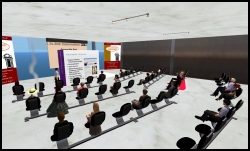
SLBA CLEThe SL Bar Association recently announced that it will be offering CLE (Continuing Legal Education) credit for legal seminars held in Second Life, starting with SLBA President ‘Solomon Cortes’ (David Naylor) presenting “Virtual World Legal Issues” July 15, 2008 at 12:00 Noon Pacific at the SLBA offices. This marks the first time that CLE credit has been offered for an exclusively in-world event. For non-attorney readers, CLE credit is a big deal to lawyers because attorneys all have to take a certain number of CLE credits each year to maintain state bar memberships — and these seminars can be expensive. The SLBA presentations will initially only be accredited for CLE in California and the United Kingdom, but some other U.S. states accept California accredited CLE programs, and eventual accreditation in other states and countries seems likely if there is interest.

The initial SLBA sessions will be offered free of charge to SLBA members — a fantastic benefit given that members pay just L$500 (about $2.20) a year in dues and that mainstream CLE seminars regularly run $100 a seat. Future SLBA CLE offerings may involve some fees, but the SLBA plans to keep the cost well below mainstream CLE — a benefit of holding these in-world.

The full schedule of the upcoming CLE offerings via the SLBA includes:

  • July 15, 2008, 12:00 noon: “Virtual Worlds Legal Issues,” ‘Solomon Cortes’ (David Naylor)
  • July 22, 2008, 12:00 noon: “Intellectual Property Enforcement in Virtual Worlds,” presented by ‘Juris Amat’ (Tamiko Franklin)
  • July 29, 2008, 12:00 noon: “Internet Fraud,” presented by ‘Theophan Paine’ (Alex Roshuk)
  • September 9, 2008, 12:00 noon: “Trademark Infringement in Virtual Worlds,” presented by ‘Legal Writer’ (Stephen Wu)
  • September 16, 2008, 12:00 noon: “Legal Research on the (Free) Internet,” presented by ‘Cat Galileo’ (Kate Fitz)

All of the seminars have been approved for California CLE credit except the last, for which approval is pending.

Offering CLE in-world is a big step for the SL Bar Association, and I’m really pleased to see it happen. I started the SL Bar Association in late 2006, but had absolutely nothing to do with this effort, which was driven by the current ‘Cortes’ administration and spearheaded by ‘Geri Kuhn’ and ‘Cat Galileo.’ I join a lot of what I know are going to be very happy attorneys who use virtual worlds in thanking them for making this happen.

Email This Post Email This Post
Print This Post (Printer Friendly Formatting) Print This Post (Printer Friendly Formatting)


Related Posts on Virtually Blind

Hernandez v. IGE CaptionThere are two new developments in Hernandez v. IGE. First, IGE has filed a declaration from CEO Brock Pierce stating that IGE merely holds stock in Affinity Media Inc. and doesn’t itself do anything or employ anyone. Second, Hernandez has moved to compel production of documents and interrogatory responses. Details follow.

For the full background of this case, see VB’s complete coverage. In brief, plaintiff is suing IGE on behalf of essentially all World of Warcraft players on the grounds that IGE, by farming gold, spamming chat, camping spawns, and generally diminishing the World of Warcraft experience, allegedly prevented players from receiving the full benefits Blizzard intended them to receive as third party beneficiaries of Blizzard’s Terms of Use and End User License Agreement.

Pierce Declaration

IGE has filed a declaration from Brock Pierce (.zip) stating that Pierce is “the sole Managing Member and sole officer of the Defendant in this action, IGE U.S., LLC a/k/a Affinity Media Holdings, LLC” and that U.S. IGE “is not engaged and does not employ anyone to engage in any form of RMT, ‘gold farming,’ ’spamming,’ auctions or any of the other activities alleged in the Amended Complaint.” Rather, “IGE U.S. consists solely of its stock holdings in Affinity Media, Inc.” The declaration was filed to support IGE’s claim in its opposition to class certification that the injunctive relief Hernandez seeks (an order closing down some of IGE’s gold farming operations) cannot be granted because IGE itself does not participate in these activities. The declaration also sheds some new light on the murky corporate structure of IGE, a subject of frequent, often entertaining speculation over at Broken Toys.

Motion to Compel

Hernandez has filed a motion to compel with exhibits (.zip) asking the court to force IGE “to produce all documents called for by plaintiff’s document request and to respond fully to plaintiff’s Interrogatories.” Hernandez argues that the motion is necessary due to “IGE’s wholesale failure to provide meaningful discovery, apart from a sparse and woefully incomplete production of scattered corporate meeting documents and reports and evasive interrogatory responses.” With less than eight weeks to go in fact discovery under the court’s current case calendar, motions like this are relatively common. The exhibits include Hernandez requests for production of documents and interrogatories to IGE, and IGE’s initial responses, for those who are interested.

Email This Post Email This Post
Print This Post (Printer Friendly Formatting) Print This Post (Printer Friendly Formatting)


Related Posts on Virtually Blind

I periodically dig around a bit to see what’s new in the browser-based “3D internet” realm because I think that the evolution of the internet into a 3D space is the long-term reason it makes sense to be paying attention to virtual worlds now — and it is a reason that skeptical colleagues understand. Earlier this year, I came across Smallworlds, which integrates YouTube videos, Twitter feeds, and various social networking sites into a browser-based virtual world. Today, I found ExitReality (currently in beta) which raises the stakes.

After signing up for ExitReality’s beta, downloading a browser plugin, and typing in VB’s address, I found myself walking through my own site as an avatar in a full-sized browser window. ExitReality basically makes your blog, storefront, or personal web page into a virtual world, and it does this on the fly. Cool, huh?

Here’s a big screenshot so you can see what I’m talking about without signing up for the beta and jumping through the download hoops yourself.

ExitReality Screenshot

You can even install couches and jukeboxes in the 3D version of your site so people can have their avatars sit down and listen to an audio stream while they chat about your articles or products or whatever in real time.

ExitReality is not perfect. It wouldn’t load when I had my laptop hooked into a big LCD monitor, it crashed a couple of times, it has a name that may alienate even more people than “Second Life” does, and most critically, because no one writes sites with 3D navigation in mind yet, navigating this way was actually less intuitive than navigating most flat sites. Who cares? I am walking around my own web site this morning, and that makes me grin.

Email This Post Email This Post
Print This Post (Printer Friendly Formatting) Print This Post (Printer Friendly Formatting)


Related Posts on Virtually Blind

This one may make your head hurt a little bit, but it highlights a problem that is coming faster than you might think. Three steps to the analysis…

Spore1) 3D games like the upcoming Spore (and, of course, free-form social environments like Second Life) let users create some pretty cool stuff. For example, I created this little guy to the right in about five minutes using the trial of the Creature Creator tool for Spore.

The ability to create cool 3D stuff is going to become more prevalent in games and virtual worlds because users now demand customization options. Even where you’d not expect it — like Madden ‘08 or a racing game — a lot of players spend a lot of time customizing. Madden players create custom uniforms and accessories, and the car customization in Forza Motorsport 2 appears to trump actual play for some users. Wherever there is customization available, potential trademark and copyright infringement is fairly common — as the links above demonstrate.

2) In most games, you agree — via a clickthrough screen — that you have no ownership over the cool stuff you create. Even if you aren’t ripping off Lost or Nike (see links above) and are only doing original creations, you have to be careful about intellectual property issues. Sometimes (like in Second Life) the Terms of Service allow you to retain ownership of the intellectual property in your in-world creations. For most games, though, the Terms of Service and End User License Agreements say you own absolutely nothing.

For Spore’s “Creature Creator,” for example, you have to agree that:

EA owns all of the right, title and interest in the Spore Creature Creator, the assets included in the Creature Creator for building and animating creatures and for creating backgrounds and video clips, and all derivative works comprised of those assets, including the Spore creatures that you create, animate, and capture in screen shots or video clips using the Spore Creature Creator.

And here’s where it gets interesting…

3) We’re getting close to consumer-level 3D fabrication technology, which will let you make plastic 3D models (a.k.a. professional-grade home-made toys) based on that cool stuff you create on your computer. The technology is already reasonably priced for small businesses, and in fact, one company, Fabjectory is already selling plastic versions of Second Life avatars.

I’ve just started to wrap my head around this, but I see at least a couple of legal issues here right off the bat. The obvious one is that people are going to be able to “print” (and sell) Spore and other game creations in violation of the games’ Terms of Service and EULAs. The less obvious one is that this raises the stakes for copyright and trademark infringement in open-creation spaces — a lot. Once people are “printing” Batman and Harry Potter toys they’ve created in Second Life (rather than buying the ones DC Comics and Warner Brothers have licensed for sale at the mall) license holders will be further motivated to pay close attention to how their intellectual property is being represented in-world.

Thanks to reader C. Sven Johnson for the heads-up on this. Sven maintains the thought-provoking reBang weblog, where he covers product design, mixed reality, and lots of other cool stuff.

Email This Post Email This Post
Print This Post (Printer Friendly Formatting) Print This Post (Printer Friendly Formatting)


Related Posts on Virtually Blind

Metanomics LogoI’m pleased to announce that starting Monday, I will be appearing periodically (in avatar form) as a legal correspondent for the second season of Cornell Professor Robert Bloomfield’s excellent virtual worlds interview show, Metanomics.

My first appearance will be Monday, June 30th, at 12 noon Pacific time. I’ll be starting the hour with a brief segment on international jurisdiction, focusing particularly on the questions raised by open standards and open source platforms. The show’s featured guest will be Cisco’s Christian Renaud, who, I suspect, may also address these future possibilities from a technical/business perspective.

From the Metanomics announcement:

Christian Renaud, Chief Architect of Networked Virtual Environments for the Cisco Technology Center. Renaud announced Friday that he will be leaving Cisco. From the heart of Cisco’s incubator for emerging virtual technologies, we’ll explore Renaud’s experience, and you’ll find out why he believes that “Second Life and its walled/closed ilk will fade into the sunset in the next 24-36 months.”

Metanomics launched its second season last week with guests Rik Panganiban of Global Kids and Douglas Thomas of USC’s Annenberg School of Communication. The show takes place live each Monday in various virtual worlds (most often in Second Life). Past shows are available at SLCN.tv.

Email This Post Email This Post
Print This Post (Printer Friendly Formatting) Print This Post (Printer Friendly Formatting)


Related Posts on Virtually Blind

Hernandez v. IGE CaptionIGE has filed a brief (.pdf) in opposition to last month’s motion for class certification in Hernandez v. IGE. IGE also filed exhibits (.zip) which feature excerpts from the deposition (an out of court proceeding where someone has to answer questions under oath) of plaintiff Hernandez.

IGE’s chief argument is that Hernandez does not have standing to sue because the World of Warcraft “End User License Agreement states that World of Warcraft players ‘have no interest, monetary or otherwise, in any feature or content contained in the Game.’” IGE argues:

[T]he very agreements upon which Hernandez relies foreclose him from bringing suit. Hernandez insists that the EULA and TOU prohibit IGE U.S. from engaging in RMT, yet it is undisputable that he has no right to enforce those agreements – let alone a cognizable interest in World of Warcraft or any aspect of its game play. In short, Hernandez has not been legally injured, and has waived the right to pursue such injury in any event.

IGE also argues that the class should not be certified because it includes both gold buyers and non-gold buyers, and because different potential class members were subject to different versions of the EULA and TOS.

VB does not typically comment on active lawsuits (and notably, the following comments do not go to the general merits of this case) but I cannot resist pointing out a couple of things here.

Read the rest of the post »

Email This Post Email This Post
Print This Post (Printer Friendly Formatting) Print This Post (Printer Friendly Formatting)


Related Posts on Virtually Blind


Page 3 of 31«12345»...Last »